INDEPENDENT LONDON TRAVEL GUIDES

Dreaming London

PLAN • EXPLORE • EXPERIENCE LONDON

Author: Sophie

  • South Bank London: A Thames Walk from Westminster to Borough Market and Tower Bridge

    South Bank London: A Thames Walk from Westminster to Borough Market and Tower Bridge

    The South Bank is one of the best ways to understand London without entering a single attraction. The Thames provides direction, the skyline keeps changing, and major landmarks arrive in a natural sequence: Westminster, the London Eye, Southbank Centre, the National Theatre, Tate Modern, Shakespeare’s Globe, Borough Market and — if you continue — Tower Bridge. The danger is overplanning. This walk is strongest when you choose one interior stop and let the river connect everything else.

    Best forFirst visits, Thames views, walking, photography, families
    Minimum time2 hours direct; half or full day with stops
    StartWestminster/Waterloo
    FinishLondon Bridge or Tower Bridge
    Best tipDo not book several timed attractions back-to-back along the route

    Start at Westminster Bridge and cross to the south side

    Beginning at Westminster gives you the classic contrast between Parliament and the modern riverside. Cross Westminster Bridge to the South Bank and look back. This viewpoint immediately establishes the river as your map.

    From here the London Eye is close, but decide before the day whether you want to ride it. Buying a ticket impulsively can add a long queue and shift the rest of your schedule. If you only want the skyline, our best London views guide compares free and paid alternatives.

    Southbank Centre: use the building, not just the riverfront

    The Southbank Centre is the UK’s largest arts centre and includes Royal Festival Hall, Queen Elizabeth Hall, Hayward Gallery and other spaces. The public foyers, exhibitions and free events can make it a useful indoor break during a long river walk. The programme changes constantly, so check what is happening on your dates.

    This is particularly valuable in uncertain weather. You can move between river views and indoor cultural space without abandoning the route. It is one reason the South Bank works so well on a first visit: bad weather does not automatically destroy the day.

    National Theatre and brutalist London

    Continue east and the architecture becomes a major part of the experience. The National Theatre and Southbank Centre represent postwar cultural London and divide opinion visually. Even if you dislike brutalism, the riverside terraces, concrete forms and public spaces are worth noticing because they tell a different story from royal Westminster.

    Travel guides often treat architecture as background. On this walk, make it part of the route. London is compelling because medieval, Victorian, postwar and contemporary structures appear in the same sightline.

    Gabriel’s Wharf, Oxo Tower and the everyday river

    Between the major cultural buildings and Tate Modern are smaller riverfront spaces, cafés, benches and side streets. This middle section is where you should stop chasing landmarks and watch the Thames. Tides, working boats, bridges and changing views make the river feel active rather than decorative.

    If you are travelling with children, this is a good point for an unplanned break. If you are travelling alone, it is one of the best places to slow down and photograph details instead of only skylines.

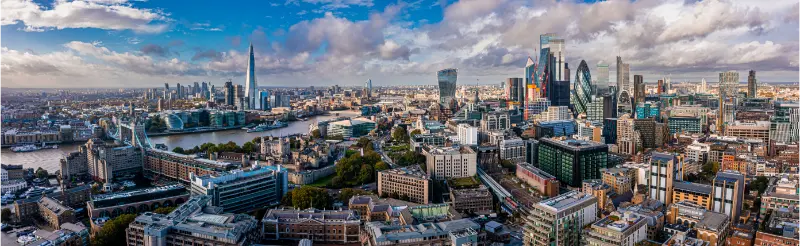
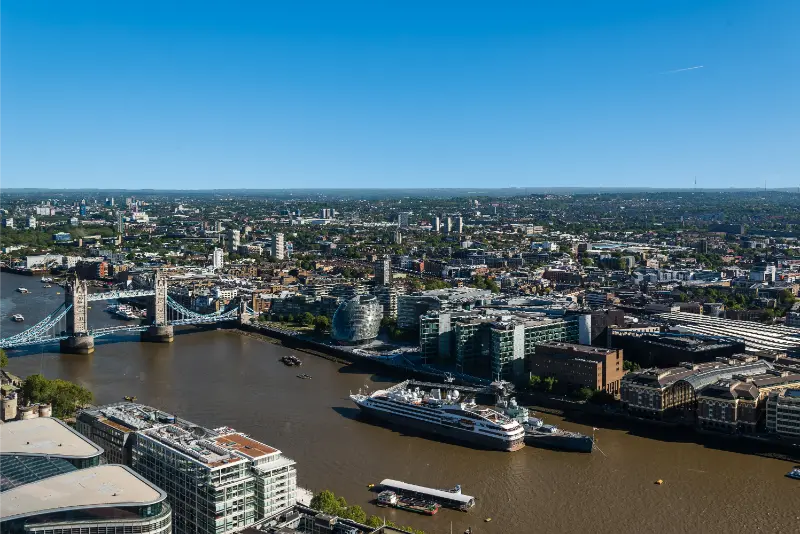
    HMS Belfast Tower Bridge and River Thames London

    Tate Modern and Millennium Bridge

    Tate Modern occupies the former Bankside Power Station and is one of the route’s biggest anchors. General collection access is free, while some exhibitions are ticketed. If modern and contemporary art matters to you, give it real time; if not, enter briefly for the architecture and continue.

    Millennium Bridge connects Bankside with St Paul’s Cathedral across the river. Crossing halfway and looking in both directions is one of the easiest free viewpoints in central London. You can continue to St Paul’s and rejoin the South Bank later, but avoid creating unnecessary zigzags if your final destination is Borough Market or Tower Bridge.

    Shakespeare’s Globe and historic Bankside

    East of Tate Modern, the riverfront enters an area strongly associated with historic theatres and entertainment. Shakespeare’s Globe is a modern reconstruction near the sites connected with Elizabethan theatre. Even without a performance ticket, the location helps explain why Bankside developed differently from the City across the river.

    Nearby streets also contain remnants and references to medieval and early modern Southwark. This is a good place to leave the exact river edge briefly, then return before reaching Borough Market.

    Borough Market: treat it as a meal stop, not the finish line

    Borough Market is one of London’s best-known food markets and can be extremely busy. If you are hungry, walk through once before choosing. If you are not hungry, do not force a market meal simply because it appears on every itinerary. Southwark has many restaurants outside the main market lanes.

    Market opening patterns and trader schedules can vary, so check current information if it is a priority. Our London markets guide compares the experience with Camden, Spitalfields and other options.

    Continue to Tower Bridge if you still have legs

    From London Bridge/Borough, continuing east toward Tower Bridge adds one of the most dramatic finishes in London. You pass HMS Belfast and views toward the Tower of London before reaching the bridge itself. Crossing Tower Bridge puts you beside the Tower and connects naturally with a river boat or the City.

    If you have already walked for several hours, stopping at London Bridge is completely reasonable. The best itinerary is not the one that proves you can keep walking. It is the one where you still enjoy the final thirty minutes.
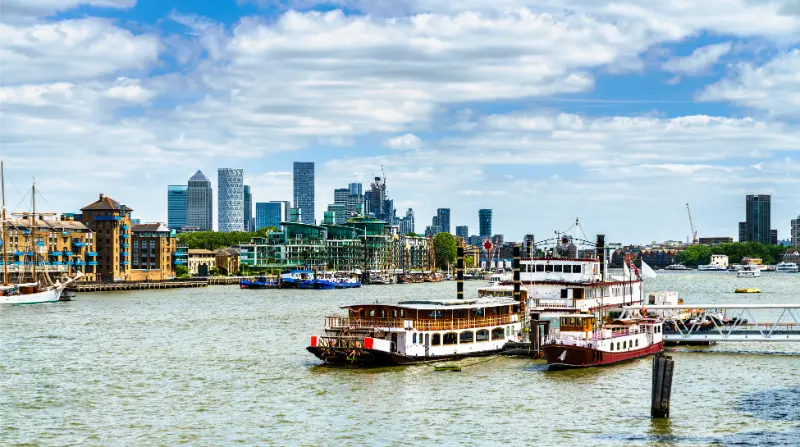
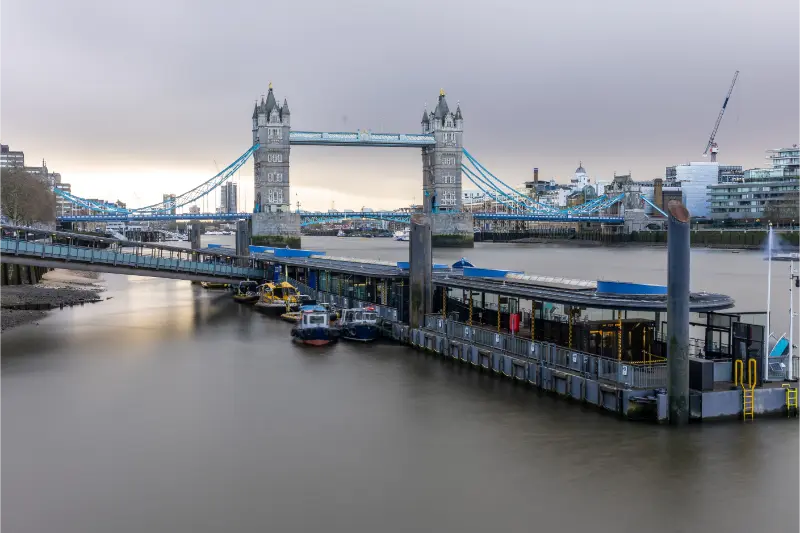
    Boats On River Thames from Tower Bridge London

    A half-day and full-day version

    For a half day, walk Westminster Bridge → Southbank Centre → Tate Modern → Borough Market, with one interior stop. For a full day, add a London Eye ride or major gallery visit, lunch, then continue to Tower Bridge and the Tower of London area. Do not attempt the Tower itself late in the day unless you have enough time to visit properly.

    This walk pairs naturally with our Tower of London guide, Thames boat guide and best London walks. Together they form one of the strongest first-time clusters on the site.

    • Half day: Westminster → Southbank Centre → Tate Modern → Borough Market.
    • Full day: add one major interior + Tower Bridge.
    • Evening: reverse parts of the route for illuminated skyline views.

    Choose the direction according to food, light and your booked attraction

    Westminster-to-Tower Bridge is the easiest first-time direction because the skyline unfolds naturally and you can finish around Borough Market or the Tower area. The reverse route is better if you want Parliament and the London Eye near dusk. If Borough Market is the lunch anchor, remember that its regular 2026 schedule has Monday closed; on that day, build the food stop elsewhere rather than arriving to an empty market frontage.

    Do not walk the whole river without entering anything unless the walk itself is the goal. Tate Modern, Shakespeare’s Globe, Southwark Cathedral and the Southbank Centre create different reasons to pause. Choose one substantial interior or performance, then let bridges and riverside sections connect it. That keeps the route from becoming a long sequence of photographs taken while tired.

    Two details that make the South Bank easier

    First, expect pinch points around the London Eye, weekend food areas and major events. The river path is public and busy, but temporary diversions can appear. Second, use bridges as part of the experience: crossing Millennium Bridge for St Paul’s or Tower Bridge for the Tower area changes the skyline and gives you a natural endpoint instead of forcing you to retrace the same bank.

    If you want a guided river walk or an activity that combines the Thames with a cruise, compare South Bank and Thames experiences on GetYourGuide. For theatre history, our Shakespeare’s Globe guide explains when a tour or performance makes more sense.

    Frequently asked questions

    How long is the South Bank walk?

    The exact time depends on where you stop. Westminster to Borough Market can be walked comfortably in a couple of hours without long visits; continuing to Tower Bridge and entering attractions can turn it into a full day.

    Is the South Bank free?

    Walking the riverfront is free. Many cultural spaces have free public areas or collections, while rides, exhibitions and attractions may be ticketed.

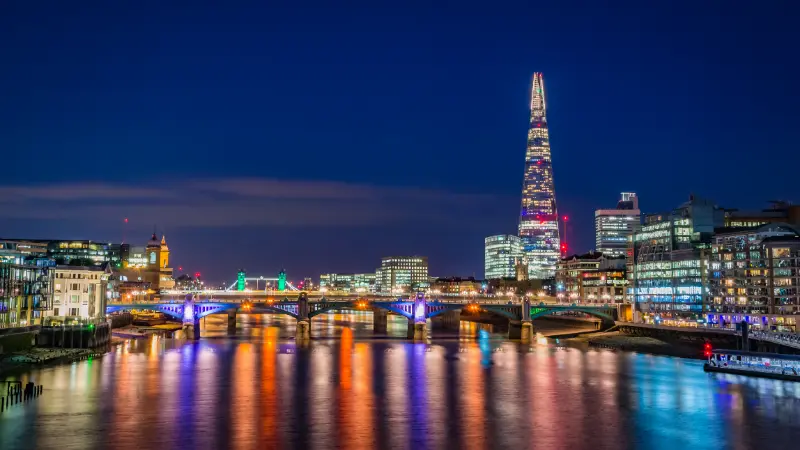
    London View from The Shard

    Is the South Bank good at night?

    Yes, especially for skyline views and atmosphere. Stick to well-used routes, keep normal city awareness and check your transport home.

    Which direction is best?

    Westminster to Tower Bridge gives a natural progression for first-time visitors, but the reverse direction is excellent in late afternoon if you want to finish with Parliament and the London Eye illuminated.

    Official information and final planning note

    For details that can change — opening times, temporary closures, booking rules, access arrangements and special events — check the official pages before travelling: Southbank Centre visitor information.

    The South Bank is a route, not a checklist. Choose one or two reasons to stop, let the river connect them and use bridges to change perspective rather than walking until every skyline view starts to feel the same.

    Shakespeare’s Globe as a South Bank anchor

    If theatre history interests you, the Shakespeare’s Globe guide explains the difference between taking a tour and attending a performance. The Globe fits naturally between Tate Modern, Millennium Bridge and Borough Market, so there is no need to make a separate cross-city journey.

    Finish high above London Bridge

    For a paid skyline finale near Borough Market, see our View from The Shard guide.

    County Hall attractions

    If you want a paid indoor stop on this walk, compare SEA LIFE London Aquarium with the theatrical London Dungeon before booking multiple attractions back-to-back.

    If you want an immersive historic attraction on the river, our HMS Belfast guide explains tickets, timing and the physical route through the ship.

  • Buckingham Palace: What You Can Actually Visit and How to Plan It

    Buckingham Palace: What You Can Actually Visit and How to Plan It

    Buckingham Palace creates more confusion than most London landmarks because ‘visiting the Palace’ can mean four different things: seeing the exterior, watching Changing the Guard, touring the State Rooms, or visiting nearby royal attractions such as the Royal Mews and The King’s Gallery. These experiences follow different schedules. The Palace is a working royal residence, so access is seasonal and can change. Plan the exact experience you want before you arrive at the gates.

    Best forRoyal history, ceremonial London, first-time visitors
    Minimum time30–45 min exterior; 2–3 hours for State Rooms
    Nearest stationsVictoria, Green Park, St James’s Park, Hyde Park Corner
    Key pointState Rooms are seasonal; ceremonies follow separate schedules

    What you can see for free all year

    The exterior of Buckingham Palace, the gates and the Victoria Memorial can be seen from public areas throughout the year, subject to security measures and events. Walking through St James’s Park or along The Mall makes the approach much more memorable than arriving directly from a station.

    If your only goal is a photograph, you do not need to allocate half a day. Combine the Palace with Westminster, Green Park, St James’s or Piccadilly. Our Westminster guide gives a natural route from Parliament to the Palace.

    State Rooms: seasonal general opening

    The State Rooms are used for official and ceremonial entertaining and open to general visitors during a seasonal period rather than year-round. In 2026 the standard summer opening runs daily from 9 July to 31 August, then Thursday to Monday from 3 to 27 September. Other guided products can operate on selected dates outside that pattern, so use the Royal Collection Trust calendar for your exact day.

    A standard visit is a substantial interior experience, not a quick look through one room. Security, the route through the rooms and the exit through the garden all add time. Book ahead if this is one of your trip priorities.

    Important 2026 restoration note

    For the 2026 summer opening, ongoing reservicing works affect parts of the visitor route. Royal Collection Trust states that the White Drawing Room is not accessible during the 2026 opening and that parts of other spaces are affected by works. This is exactly the kind of time-sensitive detail that makes official sources essential.

    If you are reading this article after 2026, treat that note as historical context and check the current visitor page. Major working palaces change access more often than static monuments.

    Changing the Guard: do not arrive based on a generic timetable

    Changing the Guard is a ceremonial event associated with Buckingham Palace, but the schedule varies and can be altered for operational, weather or ceremonial reasons. Do not rely on an old blog post that says it happens at the same time every day.

    If the ceremony is a priority, check the official current schedule close to your visit and arrive earlier than the ceremony itself. The forecourt sightline becomes crowded. An alternative is to understand the wider guard-mounting movement around St James’s Palace and Wellington Barracks rather than focusing only on the front gate.

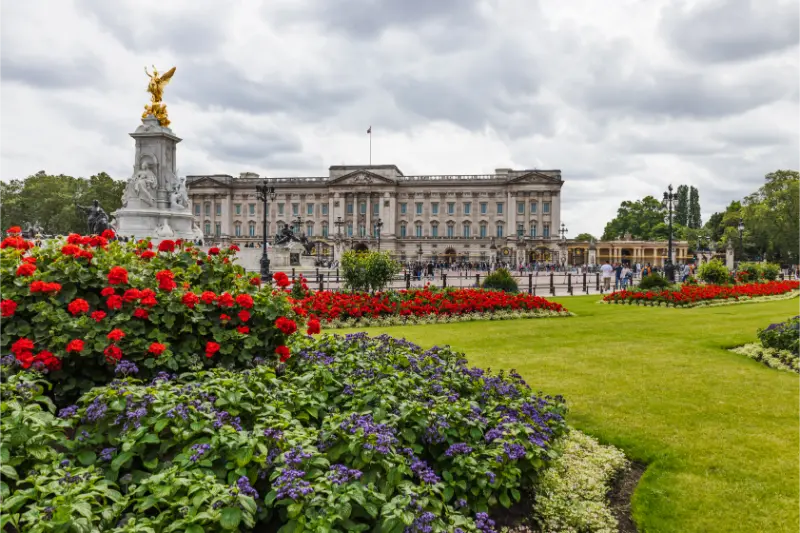
    Buckingham Palace Victoria Memorial and Gardens London

    Royal Mews and The King’s Gallery are separate experiences

    The Royal Mews and The King’s Gallery are adjacent royal attractions with their own tickets and schedules. The Mews focuses on ceremonial transport and the working stables; the Gallery hosts changing exhibitions from the Royal Collection. Depending on your interests, either may be more rewarding than trying to time a crowded guard ceremony.

    Because they are separate, check opening days carefully. A common travel-planning mistake is assuming every attraction around Buckingham Palace follows the same calendar.

    The best approach through St James’s Park

    From Westminster, walk through St James’s Park to the Palace. This route gradually reveals the royal landscape and gives you multiple views rather than dropping you at the gates from underground. From the Palace, continue through Green Park to Piccadilly or north toward Mayfair.

    The parks also create backup options. If the Palace area is unusually crowded, step away for twenty minutes and return later. Central London is easier when you use parks as flexible space between timed activities.

    Where to stand for photographs

    The Victoria Memorial provides the classic frontal perspective, while The Mall creates a long ceremonial view. Move around rather than trying to capture every photograph from directly at the gates. Respect barriers and police instructions; security arrangements can change without notice.

    For quieter photographs of royal London, walk toward St James’s Palace, Clarence House exterior areas and the streets of St James’s. These do not replace Buckingham Palace, but they add context and reduce the sense that royal London is one crowded forecourt.

    A realistic royal half-day

    Start at Westminster or Trafalgar Square, cross St James’s Park, reach Buckingham Palace, then choose one main royal experience: State Rooms when open, the Royal Mews, The King’s Gallery, or the guard ceremony. Afterward continue through Green Park to Piccadilly and St James’s.

    Big Ben and Houses of Parliament at Sunset London

    This is usually better than trying to do every royal attraction in one day. If your visit includes Windsor Castle on another day, avoid duplicating too many palace interiors. The first-time London guide can help you decide how much royal sightseeing belongs in the wider trip. Choose experiences that show different aspects of monarchy rather than collecting royal buildings.

    The 2026 State Rooms calendar is more specific than “summer opening”

    For 2026, Royal Collection Trust lists the State Rooms open daily from 9 July to 31 August. From 3 to 27 September, they are open Thursday to Monday. That distinction matters if you are building a September itinerary: a Tuesday or Wednesday visit may give you the exterior and nearby royal sights but not standard State Rooms admission. Future seasons can change completely, so treat these dates as 2026 information, not an evergreen rule.

    The 2026 visitor route is also affected by the Buckingham Palace Reservicing programme. Royal Collection Trust states that the White Drawing Room is not accessible during the summer opening, while parts of the Ballroom, Music Room and Bow Room are affected by works. This does not make the visit pointless, but it should shape expectations—especially for repeat visitors who remember a different route.

    Build the royal day around one interior

    If you book the State Rooms, let that be the main paid royal interior of the day. Walk through St James’s Park, see the Palace exterior and then continue through Green Park or St James’s after the visit. The Royal Mews and The King’s Gallery have their own calendars, so adding them automatically can turn an elegant royal day into several rounds of security and timed entry.

    For guided combinations or alternative ticket products, compare Buckingham Palace experiences on GetYourGuide. Always confirm Changing the Guard separately on the official schedule; it is not a guaranteed daily event and can be altered for ceremonies or weather.

    Changing the Guard is not the same thing as visiting the Palace

    Many first-time visitors merge these into one activity, but they require different planning. The guard ceremony is an outdoor event with its own schedule, crowd patterns and viewing compromises; a State Rooms ticket is a timed interior visit with security. Trying to stand in the densest ceremony crowd and then sprint to a palace entry slot is an unnecessary risk. If the ceremony matters, give it its own time block or view it from a less compressed position along the route.

    The Palace also sits in a useful royal cluster. St James’s Park, The Mall, Clarence House, Green Park and St James’s streets provide context without extra tickets. The Royal Mews focuses on state transport and working royal vehicles, while The King’s Gallery is an art exhibition space; neither is a miniature version of the State Rooms. Choosing one of these because it matches your interests is better than buying every nearby royal ticket.

    Hyde Park Aerial View London

    Finally, plan the exit. A State Rooms visit can take two or more hours once security and the route are included, and the visitor flow may leave you in a different position from where you mentally started the day. Keep the next activity flexible and nearby rather than booking a tight cross-city transfer immediately afterward.

    Frequently asked questions

    Can you go inside Buckingham Palace?

    Yes, but general access to the State Rooms is seasonal rather than year-round. Other guided tours and nearby royal attractions operate on different dates.

    Is Changing the Guard every day?

    No fixed evergreen statement is safe. Schedules vary and can change. Check the official calendar close to your visit.

    How long do the State Rooms take?

    Allow roughly two to three hours including security, the multimedia route and the garden exit, rather than treating it as a quick interior.

    Is Buckingham Palace free?

    Seeing the exterior is free. State Rooms, Royal Mews, The King’s Gallery and special tours are ticketed experiences.

    Official information and final planning note

    For details that can change — opening times, temporary closures, booking rules, access arrangements and special events — check the official pages before travelling: Royal Collection Trust – Buckingham Palace, Buckingham Palace highlights.

    Buckingham Palace is easiest to plan when you separate the free public realm from the seasonal interiors. Check the date, choose one paid royal experience and let the parks and St James’s streets provide the flexible part of the day.

    Walk through St James’s after the palace

    Instead of heading straight to the Tube, follow our St James’s walking guide through royal streets, Jermyn Street and Green Park.

  • British Museum: A 2–3 Hour Route That Makes Sense for First-Time Visitors

    British Museum: A 2–3 Hour Route That Makes Sense for First-Time Visitors

    The British Museum is free to enter for the permanent collection, enormous enough to overwhelm almost anyone, and much better when you arrive with a route. Trying to ‘see the museum’ in one visit is the wrong goal. A first-time visitor should aim to understand a few connected stories, see several world-famous objects, and leave before fatigue turns the final galleries into corridors. Two to three hours is a strong first visit; a Friday late opening can be useful if it matches your dates.

    Best forWorld history, archaeology, ancient cultures, rainy days
    Minimum time2 hours; 3 hours for a strong first visit
    Nearest stationsTottenham Court Road, Holborn, Russell Square, Goodge Street
    AdmissionPermanent collection free; advance free booking recommended

    Book the free entry slot if you know your date

    The British Museum’s permanent collection has free admission, but the museum recommends advance booking. Walk-up entry can be available subject to capacity, which means a spontaneous visit is possible but not guaranteed in the same way on very busy days.

    This is a good example of a London planning principle: free does not mean frictionless. Booking a free slot costs nothing and protects the rest of your day. Special exhibitions may require separate paid tickets and timed entry.

    Begin in the Great Court and make a plan before moving

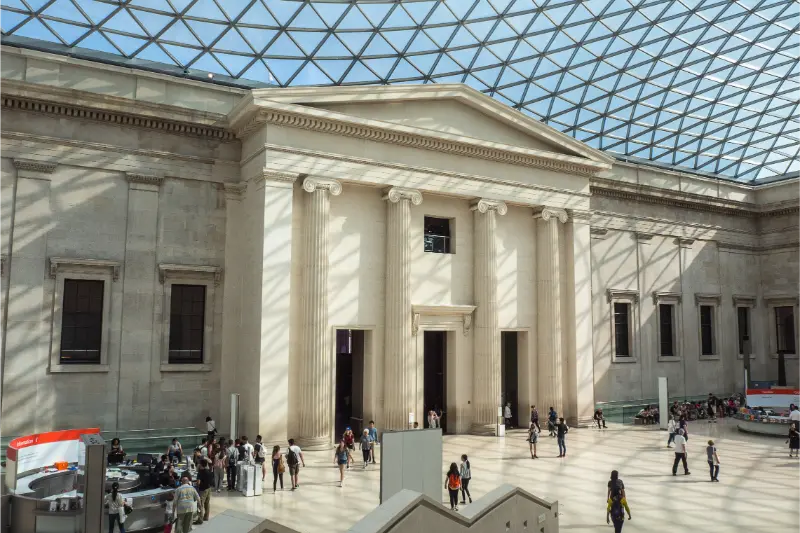
    The Great Court is not just an entrance hall; it is a useful orientation space beneath the glass roof around the Reading Room. Take two minutes with the map before entering the galleries. Decide on a route based on themes rather than object fame alone.

    If you arrive and immediately follow whichever crowd is moving fastest, you can spend an hour in ancient Egypt without realising you have skipped the parts that interested you most. Museum fatigue begins with indecision. A map is more valuable here than a list of twenty must-sees.

    A strong two-to-three-hour first route

    One effective first route starts with ancient Egypt and the Rosetta Stone, continues toward Assyria and the ancient Middle East, then moves to Greek and Roman galleries. From there, go upstairs for Sutton Hoo and medieval Europe, and finish with one gallery that reflects your personal interest — the Islamic world, clocks and watches, Japan or another region.

    This is not an official compulsory route and gallery availability can change. The Museum itself warns that rooms may close at short notice. The purpose is to create a narrative arc and reduce backtracking. Check the current map before visiting.

    • Anchor 1: Rosetta Stone and Egyptian sculpture.
    • Anchor 2: Assyrian reliefs / ancient Middle East.
    • Anchor 3: Greek and Roman world.
    • Anchor 4: Sutton Hoo / medieval Europe.
    • Final choice: one specialist gallery you genuinely care about.

    The Rosetta Stone: stop for context, not only a photo

    The Rosetta Stone is famous because the text appears in multiple scripts and was central to the decipherment of Egyptian hieroglyphs. The display is often crowded, so it helps to know why you are looking at it before joining the semicircle of phones.

    Photograph it if you want, then step aside and read about the scripts and translation. The object becomes more meaningful as evidence of language, power and scholarship rather than merely one of the museum’s celebrity exhibits.

    British Museum Visitors London

    Egyptian mummies: expect density and crowds

    The upper-floor Egyptian galleries are among the most popular sections. If mummies are a priority, visit earlier in your route rather than leaving them until you are exhausted. The display covers funerary practices, beliefs and daily life across long periods; it is easy to reduce the section to spectacle if you move too fast.

    Families often spend longer here than expected. Build that into your timing and do not promise five other major galleries afterward. A museum visit with children works better when everyone chooses one object or story to remember.

    The Parthenon sculptures and contested heritage

    The Parthenon sculptures are among the museum’s most internationally debated holdings. Any useful guide should acknowledge that their ownership and requested return are contested, particularly by Greece. The museum presents its own position, while Greek authorities and the Acropolis Museum have long argued for reunification in Athens.

    You do not need a travel article to decide the dispute for you. What matters for visiting is understanding that these are not culturally neutral display objects without a modern political history. Read the gallery interpretation and, if the issue interests you, compare primary institutional sources from both sides.

    Sutton Hoo and British history: do not stop at the ancient Mediterranean

    First-time visitors often spend so long in Egypt and Greece that they miss medieval and early English material. The Sutton Hoo gallery is an excellent counterbalance because it shows archaeology closer to home and connects objects with burial, status and early medieval society.

    The Lewis Chessmen and other medieval objects nearby make this part of the museum surprisingly accessible even for visitors who normally think they prefer ancient history. Give yourself permission to leave one giant collection area before you have seen every case.

    Friday late opening can transform the experience

    The museum currently opens later on Fridays, which can be useful for travellers who want to combine Bloomsbury with Soho or Covent Garden. Late hours do not guarantee empty galleries, but they change the rhythm of the day and can free your prime daylight hours for outdoor sightseeing.

    Artificial Moon Installation Natural History Museum London

    Check the official site because special events and closures can affect the schedule. If you visit late, plan dinner nearby instead of taking a long cross-city journey afterward. Soho, Covent Garden and Fitzrovia are all walkable depending on where you finish.

    Combine the museum with Bloomsbury, not another mega-museum

    After two or three hours inside, walk through Bloomsbury squares or continue south to Covent Garden and Soho. This creates contrast between collections and city life. Our Covent Garden guide and Soho guide are designed to connect naturally from the museum.

    If rain continues, you can extend the visit or use our rainy-day London itinerary. Just remember that museum time is not automatically better because it is free; leave while you are still interested.

    Use the British Museum’s current hours strategically

    The museum is currently open daily from 10:00 to 17:00, with Friday opening until 20:30; advance booking of the free general-admission slot is recommended and helps guarantee entry during busy periods. Friday evening is particularly useful if your daytime schedule is crowded, but not every gallery necessarily remains open late. Check the museum’s live gallery-closure information before building a route around one specific room.

    A focused first visit should have a theme rather than a floor-count target. Ancient Egypt, Greece and Rome, Mesopotamia, or a cross-cultural route built around objects that changed how people wrote, traded or worshipped will stay in your memory longer than racing through twenty rooms. If one gallery is unexpectedly closed, move to the next object on your theme instead of trying to redesign the whole visit in the Great Court.

    When a tour adds value

    The British Museum is free, but interpretation is the scarce resource. A specialist guide can be worthwhile if you want a coherent historical argument rather than a highlights checklist. Otherwise, use the museum map and its own audio resources, choose six to ten objects and stop before museum fatigue turns the final rooms into background scenery.

    You can compare British Museum guided tours on GetYourGuide. If you visit independently, combine the museum with Bloomsbury, Covent Garden or Soho rather than immediately crossing London to another giant collection.

    London Skyline with The Shard

    Entrances, bags and avoiding the first bottleneck

    The museum can become busy around opening and during school-holiday periods, so the advantage of a booked free slot is predictability rather than paid priority access. Arrive with only the bag you need, follow the current entrance guidance and do not schedule another timed attraction immediately after a two-hour museum route. Gallery closures and security queues are normal operational realities in a building of this scale; a small time buffer keeps them from turning into stress.

    Frequently asked questions

    Is the British Museum really free?

    General admission to the permanent collection is free. Special exhibitions and some events can require paid tickets.

    Do you need to book?

    Advance booking is recommended and useful during busy periods. Walk-up entry may be available subject to capacity.

    How long should a first visit take?

    Two to three hours is a strong first visit. A full day is possible for enthusiasts, but most travellers learn more by returning another time than by pushing through fatigue.

    When is the British Museum open late?

    The current published schedule includes Friday opening until 20:30, but always confirm the date-specific hours before visiting.

    Official information and final planning note

    For details that can change — opening times, temporary closures, booking rules, access arrangements and special events — check the official pages before travelling: British Museum – Plan your visit, British Museum map.

    The British Museum becomes manageable as soon as you stop trying to “see the museum” and start following a question, period or set of objects. A shorter visit with a clear theme is often more memorable than an exhausted full-day sweep.

    Do not leave Bloomsbury too quickly

    After the museum, use our Bloomsbury neighbourhood guide for garden squares, bookshops and smaller museums nearby.

  • Tower of London: How to Visit It Properly and Avoid Wasting Half the Day

    Tower of London: How to Visit It Properly and Avoid Wasting Half the Day

    The Tower of London is one of the few London attractions where arriving without a strategy can cost you more than money: it can cost half a day in queues and indecision. The site is a fortress, palace, prison, armoury, treasury and place of execution layered across nearly a thousand years. A strong visit needs priorities. For most first-time visitors, that means seeing the Crown Jewels early, joining a Yeoman Warder tour, entering the White Tower and leaving enough time to walk the walls without rushing.

    Best forMedieval and royal history, Crown Jewels, families, first visits
    Minimum time3 hours; 4 hours is more comfortable
    Nearest stationsTower Hill, Tower Gateway, London Bridge across the river
    Best tipArrive near opening and do the Crown Jewels before the queue grows

    Why the Tower is more than one building

    The Tower of London is a complex of towers, walls, courtyards and exhibitions rather than a single castle interior. The central White Tower dates to the Norman period, but the site expanded over centuries and served different royal and state functions. That is why a visit can feel fragmented if you follow signs randomly.

    Before entering, decide your top three priorities. For a typical first visit: Crown Jewels, Yeoman Warder tour, White Tower. Everything else becomes flexible. This prevents the common problem of spending too long in a secondary exhibition and then discovering that you have forty minutes left for the parts you came to see.

    Crown Jewels first: the simplest queue strategy

    The Crown Jewels are included with standard Tower admission and are one of the busiest parts of the site. Historic Royal Palaces advises advance booking for busy periods, and the exhibition itself can develop long lines even after you have entered the fortress.

    If seeing the jewels matters to you, head there early before wandering elsewhere. This is not about racing through the Tower; it is about doing the least flexible element first. Afterward the rest of the site becomes easier because most other spaces absorb visitors more naturally.

    Take a Yeoman Warder tour for narrative

    Yeoman Warder tours are included with admission subject to availability and are one of the best ways to turn a collection of towers into a coherent story. The tours combine major historical episodes with the lived tradition of the fortress. They are popular and can be crowded, but even visitors who normally avoid guided tours often find the context useful here.

    Check the current schedule when you enter and build around it. If you dislike large groups, listen for part of the tour and then explore independently. The objective is not to complete every activity; it is to understand why the site mattered.

    White Tower and armour: give it real time

    The White Tower is the visual and historical core of the fortress. Its interior includes the Chapel of St John and major armour displays. Stairs, circulation and crowds mean the visit can take longer than expected, especially with children or anyone who needs a slower pace.

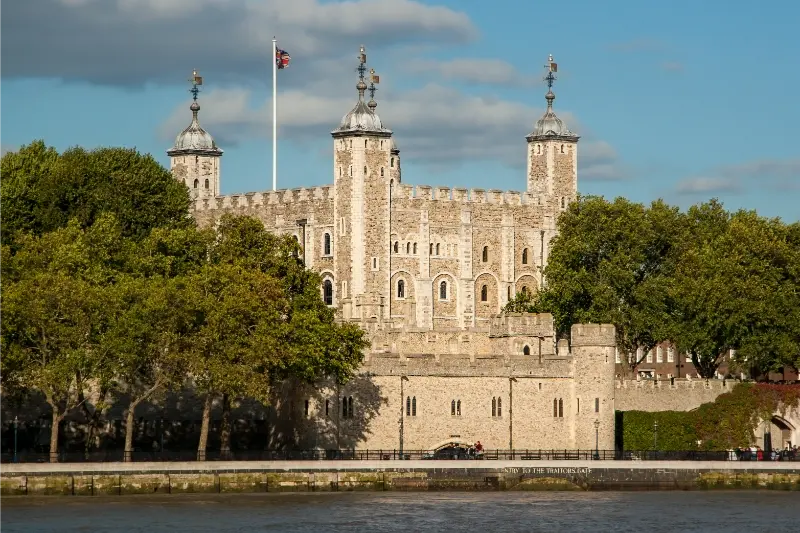
    Tower of London by River Thames

    Do not leave the White Tower until the final half hour. It deserves to be one of your anchors. If mobility access is important, review the official accessibility information in advance because the historic fabric creates limitations in some parts of the site.

    Ravens, walls and smaller towers

    The ravens are part of Tower tradition and one of the most recognisable living features of the site. The popular legend linking their presence with the survival of the kingdom should be understood as legend rather than hard historical fact. The Tower’s interest lies in how myth, ceremony and state history overlap.

    Walking the battlements and smaller towers helps visitors understand the defensive geography. Look outward as well as inward: Tower Bridge, the Thames and the modern City skyline create one of London’s clearest contrasts between medieval fabric and contemporary city.

    Executions and imprisonment: keep the history precise

    The Tower is often marketed through stories of torture and execution, but the reality is more specific. Many famous prisoners were held here, and several high-profile executions took place within the Tower, while far more public executions occurred nearby on Tower Hill. Good interpretation distinguishes documented events from later legend.

    This matters for families too. The Tower can be dramatic without becoming sensational. Focus on real people, political power and how the fortress changed function over time rather than presenting every dark story as entertainment.

    What to skip if you only have two hours

    Two hours is short. Prioritise the Crown Jewels, one section of the fortress that interests you most, and the exterior courtyards. If a Yeoman Warder tour fits perfectly, take it; if not, do not sacrifice everything else waiting for one. Leave the gift shop until the end.

    If you have three to four hours, the visit becomes far better. London is full of attractions that can be sampled quickly; the Tower is not one of them. On a first trip, it is usually smarter to do the Tower properly and postpone a minor attraction than to rush both.

    Tower Bridge Boats and River Thames London

    Pair the Tower with the river, not another huge interior

    After the Tower, walk to Tower Bridge, cross toward the south bank, or take a river service. Borough Market and the South Bank are natural continuations if you still have energy. Another major paid attraction immediately afterward can feel heavy after several hours of dense history.

    Our London by boat guide and South Bank guide show how to turn the Tower into the anchor of a wider Thames day. If this is your first visit, it also fits naturally into our essential London attractions guide.

    A route inside the Tower that reduces backtracking

    If you enter near opening and the Crown Jewels are a priority, consider seeing them early before spending time on the outer walls and exhibitions. A Yeoman Warder tour adds stories and orientation, but it is not the only way to understand the site; independent visitors can combine the White Tower, battlements and smaller towers at their own pace. The official guidance suggests allowing roughly two to three hours, and that is a realistic minimum for a first visit that does more than photograph the ravens.

    The Tower’s own visitor information notes that afternoons after midday can be quieter overall. That creates two sensible strategies: arrive early to put the Crown Jewels first, or choose a later entry if lower general crowd levels matter more and you have enough time before last admission. Do not book the final slot of the day if you want a Yeoman Warder tour, multiple towers and a slow visit.

    What to know before security

    Large suitcases and rolling luggage are not permitted, and the Tower does not provide left-luggage storage. That matters on hotel-change or departure days. Historic surfaces, spiral stairs and narrow passages also make access uneven; travellers with mobility needs should read the official accessibility information rather than assuming every section follows a modern museum route.

    For ticketed tours and combination products, compare Tower of London options on GetYourGuide. The standard admission already includes the Crown Jewels and, subject to availability, the Yeoman Warder tour, so check what a third-party product genuinely adds before paying extra.

    Crown Jewels, Yeoman Warders and the order of your visit

    The Crown Jewels are the part most likely to create a visible queue, but they are not the whole reason to come. If the line is short when you arrive, taking advantage of that can simplify the rest of the visit. If it is already long, a Yeoman Warder tour or the White Tower can give the crowd time to shift. The included Yeoman Warder tours are valuable for orientation and storytelling, but they follow a group pace; history enthusiasts may want to revisit key spaces independently afterward.

    River Thames London

    Also look down as well as up. Cobbles, slopes and historic staircases affect comfort, especially after several days of walking in London. Good shoes and a realistic route are not trivial details here. If someone in your group has limited mobility, decide in advance which sections matter most rather than discovering at each tower that the next staircase is impractical.

    Frequently asked questions

    How long should you allow for the Tower of London?

    Three hours is a sensible minimum for a first visit. Four hours gives you more room for the Crown Jewels, a Yeoman Warder tour, the White Tower and walls without rushing.

    Are the Crown Jewels included?

    Yes, entry to the Crown Jewels exhibition is included in standard Tower admission.

    Do you need to book in advance?

    You can sometimes buy on the day, but official guidance recommends advance booking during busy periods. Popular dates can sell out or develop long queues.

    Is the Tower good with children?

    Yes, especially for children interested in castles, armour and dramatic history, but the site involves substantial walking, stairs and dense interpretation. Choose a few stories rather than trying to cover everything.

    Official information and final planning note

    For details that can change — opening times, temporary closures, booking rules, access arrangements and special events — check the official pages before travelling: Historic Royal Palaces – Tower of London, Tower of London tickets and prices.

    The Tower deserves enough time to let its layers accumulate: fortress, palace, prison, armoury, mint and ceremonial space. A focused route and realistic timing reveal far more than racing from the Crown Jewels to the exit.

  • Notting Hill London: Portobello Road, Local History and a Better Walking Route

    Notting Hill London: Portobello Road, Local History and a Better Walking Route

    Notting Hill is often reduced to three images: pastel houses, the film, and Portobello Road Market. The real neighbourhood is more interesting. Caribbean history, postwar migration, activism, elegant terraces, mews, antique trading and one of Europe’s largest street festivals all overlap here. A respectful visit should go beyond photographing front doors and blocking residential steps. This guide builds a route that combines Portobello Road with the streets and history around it.

    Best forMarkets, architecture, photography, food, neighbourhood walking
    Minimum time2–3 hours; half a day on a major market day
    Useful stationsNotting Hill Gate, Ladbroke Grove, Westbourne Park
    Best tipWalk the market in one direction and exit from a different station

    Portobello Road changes by day and by section

    Portobello Road is not a single uniform market. The mix changes along the street and across the week, with antiques, food, produce, fashion and second-hand goods appearing in different concentrations. Visit London identifies Saturday as the main trading day, which also means the largest crowds. Friday can be a useful compromise for some visitors, while quieter weekdays show more of the neighbourhood itself.

    If antiques are your priority, research the current trading pattern before going rather than assuming every day is identical. If your priority is photographs and architecture, an earlier weekday visit may suit you better than maximum market density.

    Start south and walk north for a natural progression

    A good first route begins near Notting Hill Gate, enters the southern end of Portobello Road and gradually moves north toward Ladbroke Grove. You begin among colourful facades and shops, then encounter denser market sections and eventually a more mixed urban landscape toward Golborne Road.

    Walking one direction avoids unnecessary backtracking. It also makes public transport easier because Ladbroke Grove and Westbourne Park stations can serve as your exit. London neighbourhood days improve immediately when you stop insisting on returning to the station where you started.

    Photography: be a visitor, not a nuisance

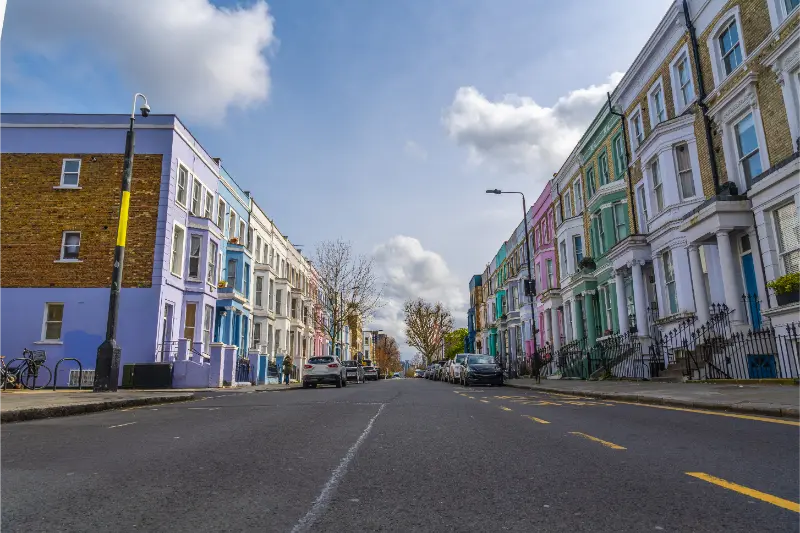
    The coloured terraces and mews are photogenic, but many are private homes. Do not sit on steps, lean on doors, enter private mews or stage long photo sessions that obstruct residents. A beautiful street is not a film set simply because it appears on Instagram.

    Wide street views usually tell the story better anyway. Look at architectural rhythm, railings, garden squares and how streets rise and curve. Notting Hill’s appeal comes from the whole urban landscape, not one turquoise door.

    The neighbourhood’s Caribbean history matters

    Notting Hill Carnival grew from the area’s Caribbean community and wider Black British cultural history. Understanding that context changes the neighbourhood from a pastel-photo destination into a place shaped by migration, racism, resistance, music and celebration. The Carnival takes place annually around the August bank holiday and dramatically changes transport, crowds and access across west London.

    If your visit is outside Carnival, you can still approach the area with that history in mind. Food businesses, cultural references and local organisations form part of the story. Avoid presenting Carnival as a decorative event detached from the community that created it.

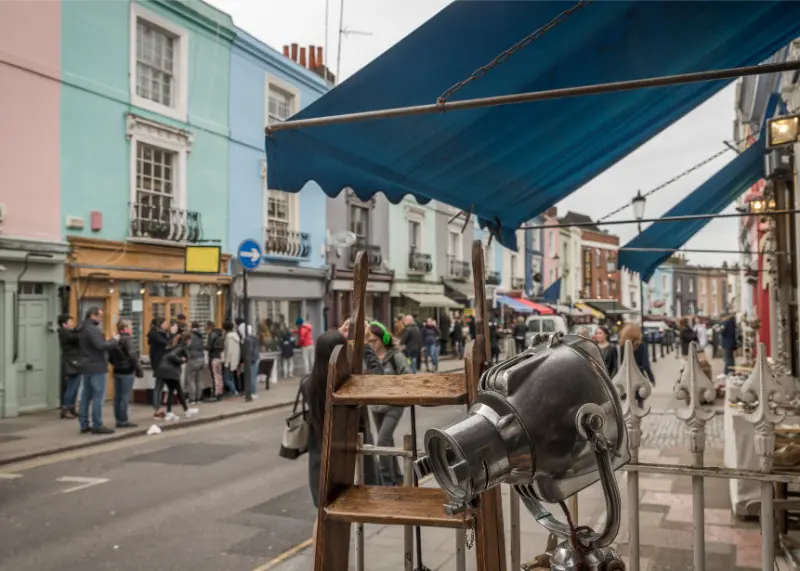
    Portobello Road Market London

    Golborne Road is worth continuing to

    Many visitors turn around before reaching the northern end of Portobello Road. Continuing toward Golborne Road extends the walk into an area with Portuguese, North African and other influences alongside market activity. The streets feel less like the movie version of Notting Hill and more like lived-in west London.

    This is often where the visit becomes more personal. You have left the best-known facades behind and are no longer walking only for a checklist. If you enjoy food, browse current cafés and shops rather than relying on a frozen list of recommendations.

    How Notting Hill differs from Kensington and Paddington

    Notting Hill sits close to several very different west London districts. South and east you reach more formal Kensington streets and major museums; northeast you move toward Paddington and Little Venice. That makes it easy to combine Notting Hill with a broader west London day.

    For a first trip, one strong option is morning at Portobello, lunch nearby, then walk toward Kensington Gardens. Another is to continue northeast and join the canal toward Little Venice. Use our best London walks and neighbourhood guide to connect the pieces.

    Where to eat and shop

    Portobello and surrounding streets offer street food, bakeries, cafés, produce and restaurants. Market days create the most choice but also the most queueing. If you want a seated lunch, consider stepping one or two streets away from the busiest section rather than waiting in the centre of the crowd.

    For shopping, decide whether you care about antiques, vintage fashion, independent design or simple browsing. Serious antique buying deserves more research than a casual walk; authenticity, condition and price can vary widely. Do not buy something expensive because the market atmosphere makes it feel urgent.

    A better Notting Hill half-day

    Begin at Notting Hill Gate before the busiest period, walk toward Portobello Road, explore the southern architecture, continue through the market, pause for food, then keep going to Golborne Road. Leave from Ladbroke Grove or Westbourne Park. If you want more walking, add a loop through residential streets only where public access is obvious and respectful.

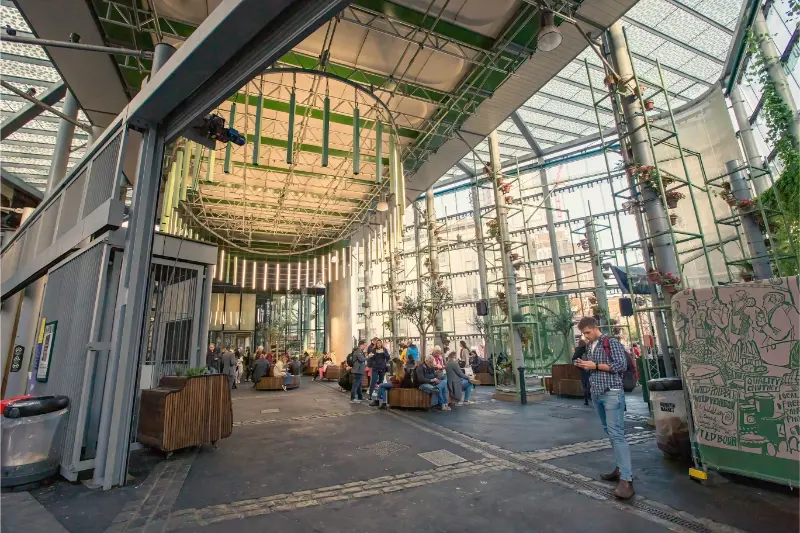
    Borough Market Glass Pavilion Southwark London

    This route works in reverse as well, especially if you want to finish nearer Kensington. The important point is to treat the neighbourhood as a linear exploration rather than repeatedly returning to the most crowded blocks.

    Choose the day according to Portobello, not just the pastel houses

    Notting Hill is two different visits: a market-focused day and a neighbourhood-focused day. Friday and especially Saturday bring more of the Portobello market experience, including antiques activity, but also the largest crowds. A quieter weekday is better if your goal is architecture, residential streets, cafés and a slower walk. Do not expect every section of Portobello Road to have the same traders every day.

    If you come for photography, remember that the famous coloured terraces are homes. Stay on public pavements, do not use private steps or doorways as props and keep groups moving. The area becomes more rewarding when you connect Portobello Road with quieter side streets, Ladbroke Square, Westbourne Grove or Holland Park rather than chasing a sequence of social-media façades.

    A better half-day route

    Start near Notting Hill Gate and walk north through residential streets before joining Portobello Road. Browse the market section that matches the day, then continue toward Golborne Road if you want a less polished extension. If you are visiting mainly for antiques or market detail, our Portobello Road Market guide is the more useful companion. For a relaxed afternoon, finish toward Kensington Gardens or Holland Park instead of taking the Tube after forty minutes.

    A local walking tour can be worthwhile if you want film, music or social-history context. Compare Notting Hill tours on GetYourGuide, but avoid tours that treat residential doorsteps as attractions in themselves.

    Portobello is a long street, not one market square

    Visitors sometimes arrive expecting a compact covered market and are surprised by how far the activity stretches. Different sections emphasize antiques, produce, fashion, second-hand goods and food, and the balance changes by day. If antiques are your main reason for coming, allow more time in the southern and central stretches instead of walking the full road at the same pace. If food and neighbourhood atmosphere matter more, continue farther north and let the route evolve.

    Notting Hill Gate is the most obvious arrival point, but Ladbroke Grove can be useful when you want to approach from the northern end or avoid retracing the same street. On a busy Saturday, do not make a restaurant booking that requires you to cross the densest market section at an exact minute. Give the market breathing room, then move toward Westbourne Grove, Kensington Gardens or Holland Park for a quieter second half.

    London Landmarks Travel Collage

    Frequently asked questions

    What is the best day for Portobello Road Market?

    Saturday is the main trading day and the busiest. Other weekdays can be better for a calmer neighbourhood walk. Check current market information if a specific category, such as antiques, is your priority.

    How long do you need in Notting Hill?

    Two to three hours is comfortable for Portobello Road and nearby streets. Allow half a day if you want to browse seriously, eat, photograph and continue to Golborne Road.

    Is Notting Hill worth visiting outside market hours?

    Yes. Architecture, cafés and neighbourhood walking remain appealing, and lower crowd levels can make the area easier to appreciate.

    Can you visit the Notting Hill film locations?

    Many exterior locations are on public streets, but some are private homes or businesses. View them respectfully and do not trespass or obstruct residents.

    Official information and final planning note

    For details that can change — opening times, temporary closures, booking rules, access arrangements and special events — check the official pages before travelling: Visit London – Notting Hill, Visit London – Portobello Road Market.

    Notting Hill is more than coloured houses and Saturday crowds. Choose the day according to whether you want Portobello at full market intensity or a calmer residential walk, then respect the fact that much of what you are photographing is somebody’s home.

    Visiting Portobello Road Market

    If the market is a main reason for coming to Notting Hill, use our Portobello Road Market guide to choose the right day, starting station and route.

    Visiting over the August bank-holiday weekend? Read our Notting Hill Carnival guide before using an ordinary neighbourhood itinerary, because road closures and station arrangements transform the area.

  • Camden London: Market, Canal and Music Without Just Following the Crowds

    Camden London: Market, Canal and Music Without Just Following the Crowds

    Camden is one of London’s most recognisable neighbourhoods, but a lot of visitors see only its busiest stretch: exit Camden Town station, walk through the crowds, buy food, photograph a shopfront and leave. That is the least interesting version of the area. A better visit connects Camden Market with the Regent’s Canal, the Stables, music history, quieter streets and — if you have time — a walk toward Primrose Hill or Regent’s Park.

    Best forMarkets, street food, music history, canal walks, alternative shopping
    Minimum time2–3 hours; half a day with canal or Primrose Hill
    Nearest stationsCamden Town, Chalk Farm, Camden Road
    Best tipEnter from one station and leave from another instead of backtracking

    Camden Market is not one single hall

    The term Camden Market covers a cluster of market spaces and trading areas around Camden Lock, the Stables and Hawley Wharf. The official market site lists different opening patterns for its components and notes that individual traders can keep different hours. That matters because a visitor expecting one traditional street market can be confused by the mixture of food halls, stalls, permanent shops and restored industrial structures.

    The most useful approach is to walk through without trying to inspect every stall. Decide whether you are primarily interested in food, vintage clothing, design, souvenirs or simply the atmosphere. Otherwise the size and repetition can become tiring before you reach the canal.

    Arrive early if crowds change your experience

    Camden is lively because it is popular, not despite it. Weekends and afternoons can be intensely busy around the station and market entrances. If you want clearer photography and easier browsing, arrive earlier and let the area fill around you. If you want maximum atmosphere, come later and accept slower movement.

    Camden Town station is convenient, but Chalk Farm can be a smart alternative if you plan to explore the Stables first or continue toward Primrose Hill. Camden Road Overground is another useful option depending on where you are coming from. The official market recommends public transport because parking is limited.

    Follow the canal: this is where Camden starts to make sense

    The Regent’s Canal passes directly through the market area and changes the pace immediately. Walk west toward Regent’s Park and Little Venice for a longer route, or east toward King’s Cross if that suits the rest of your day. Even a short canal section reveals a different side of the neighbourhood from Camden High Street.

    Our London walking guide includes the Little Venice–Camden route. If you are already visiting Camden, doing part of the towpath is one of the easiest ways to add depth without paying for another attraction.

    The Stables and railway heritage are worth noticing

    Part of Camden Market occupies former stables and industrial spaces connected to the railway era. The architecture is not merely themed decoration; it reflects the area’s transport and working history. Look for brick vaults, ramps and structural details instead of focusing only on retail units.

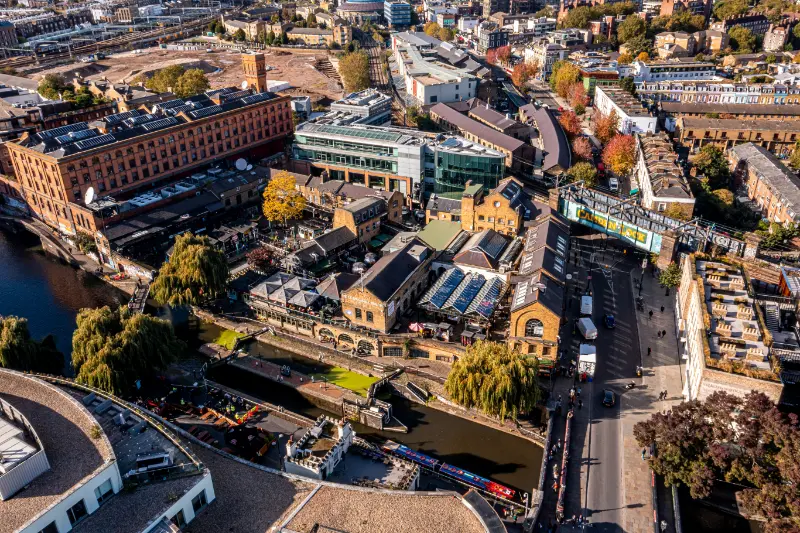
    Camden Lock Market Aerial View London

    This is also a useful reminder that Camden’s alternative reputation developed within a neighbourhood shaped by canals, railways, warehouses and working infrastructure. The market culture came later. Travel becomes more interesting when you notice what a place was before it became famous for what it sells now.

    Music history: choose current venues as well as famous names

    Camden has strong associations with punk, indie, rock and live music, and many artists are linked to local venues. However, music districts change. Clubs close, management changes and nostalgia can overpower reality. Check current venue programmes rather than assuming every name in an old guide still offers the same experience.

    If music matters to you, build the visit around an actual performance. The neighbourhood is far more memorable after dark when you have a reason to stay than when you simply photograph exteriors associated with famous musicians.

    Street food: sample intelligently

    Camden offers an enormous amount of street food, which is part of the attraction but also a source of decision fatigue. Walk through the main food area once before buying. Portions can be large, so sharing two different dishes may be more interesting than committing immediately to the first stall with a queue.

    If food hygiene, allergies or dietary needs are important, ask the trader directly and do not assume labels cover every risk. For broader market choices across London, compare Camden with Borough, Spitalfields and others in our London markets guide.

    Add Primrose Hill for contrast

    From the northern/western edge of Camden, Primrose Hill is a logical extension. The walk takes you away from the market intensity and toward one of London’s classic skyline viewpoints. The hill itself is free and works especially well in clear late-afternoon light.

    Do not add it if your schedule is already overloaded. A slow market visit plus canal walk may be enough. But if you want to understand why neighbourhood-based itineraries work in London, Camden to Primrose Hill is an excellent example: commercial chaos becomes residential streets and then open parkland within a relatively short walk.

    Covent Garden Christmas Decorations London

    A half-day Camden route

    Start at Chalk Farm, enter the Stables side of the market, work south through the main trading areas, pause by Camden Lock, then walk a section of the Regent’s Canal. From here choose your ending: continue west toward Primrose Hill/Regent’s Park, or return east toward King’s Cross if your evening plans are central.

    This route avoids the common back-and-forth between Camden Town station and the market. It also lets the neighbourhood change as you move. Pair it with our London neighbourhood guide if you want to build more days around areas rather than isolated attractions.

    How to see Camden without spending the whole day in the densest crowd

    Camden is easiest to understand when you separate the market from the neighbourhood around it. Arrive before the busiest lunch period if you want to browse stalls, then move toward the canal once the market lanes become congested. Camden Lock and the Stables have different layouts and trader mixes; walking both quickly is less rewarding than choosing the sections that actually match your interests.

    The canal is the best escape valve. Walk west toward Regent’s Park and Primrose Hill for open space, or continue farther if you are following the Little Venice–Camden canal route. Music fans should also look beyond nostalgia: check current venue calendars for concerts instead of assuming a famous address automatically produces a good night on the date you visit.

    Timing, food and what to skip

    Peak lunchtime can make choosing food harder, not better. Browse first, note two or three stalls and return after comparing them. If your priority is vintage shopping, music culture or street photography, give those interests the time; you do not need to sample every food hall. The neighbourhood is also a practical bridge to Regent’s Park, London Zoo and Primrose Hill, so it can form a coherent north-London day without repeated Tube journeys.

    Travellers who want market history or a guided food angle can compare Camden tours on GetYourGuide. If you are independent, arrive with one clear reason to visit and allow the canal or park to become the second half of the experience.

    Camden practicalities that make a real difference

    The market complex contains narrow passages, stairs and very busy pinch points, so travellers with a pushchair or reduced mobility should look at the current access information before choosing the busiest Saturday lunchtime. The canal towpath is flatter in many sections but can also become crowded with cyclists and walkers. If you want a calmer route, move away from the market entrance before joining the canal.

    For food, do one reconnaissance loop before buying. Camden’s density encourages impulse purchases, and carrying several dishes through a crowd is rarely enjoyable. If you are continuing to Primrose Hill or Regent’s Park, buying one portable item and saving a proper meal for later can make the whole afternoon easier. The goal is to use Camden’s variety, not be trapped by it.

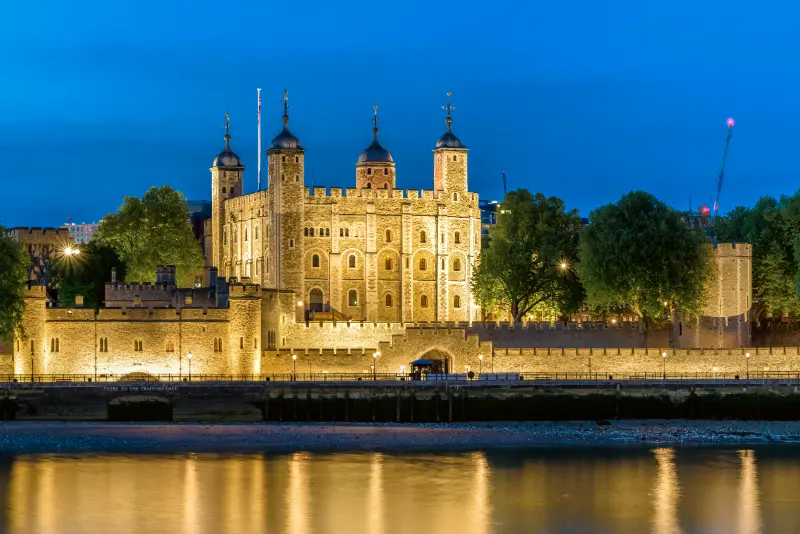
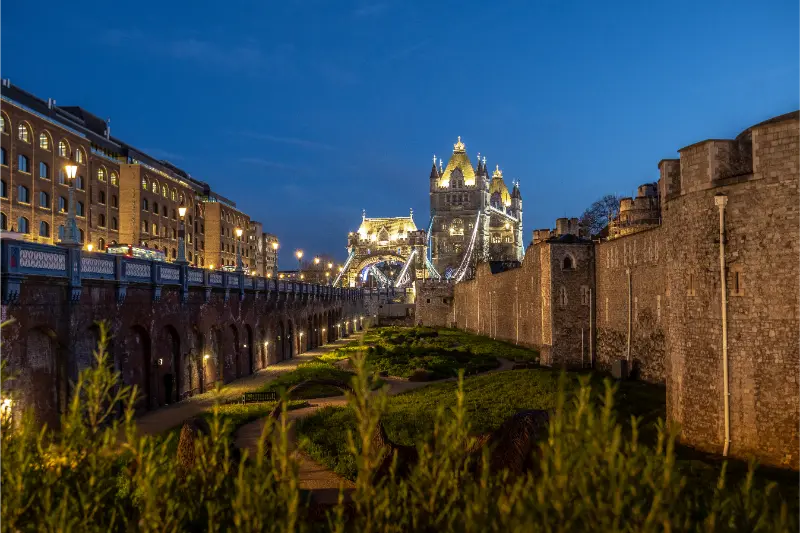
    Tower Bridge and Tower of London at Night

    Frequently asked questions

    Is Camden Market open every day?

    The main market operates daily, but individual sections and traders can keep different hours. Check the official market site before travelling if a specific shop or food hall matters to you.

    Is Camden better on a weekday or weekend?

    Weekdays are easier for browsing; weekends have more intensity and atmosphere. Choose based on your tolerance for crowds rather than assuming one is universally better.

    How long should I spend in Camden?

    Two to three hours is enough for the market and a short canal walk. Half a day is better if you add Primrose Hill, Regent’s Park or a longer canal section.

    Which station should I use?

    Camden Town is closest to the main high street, Chalk Farm is useful for the northern/Stables side, and Camden Road connects to the Overground.

    Official information and final planning note

    For details that can change — opening times, temporary closures, booking rules, access arrangements and special events — check the official pages before travelling: Camden Market official visitor information.

    Camden works best when the market is only one chapter. Pair it with the canal, Primrose Hill, Regent’s Park or a live-music plan and the area feels far less like a crowded shopping stop.

    Eating your way through Camden

    If market food is a priority, compare Camden with other areas in our London street-food guide.

  • Greenwich London: A Full-Day Itinerary by River, Park and Maritime History

    Greenwich London: A Full-Day Itinerary by River, Park and Maritime History

    Greenwich is one of the best examples of why a London trip should not stay trapped in Zone 1. In one compact day you can arrive by river, walk through a UNESCO World Heritage area, step aboard the Cutty Sark, visit major free museums, stand on the Prime Meridian, climb through a royal park and look back at the modern skyline. It feels distinct from central London without requiring a day trip outside the city.

    Best forMaritime history, views, parks, families, a slower full day
    Minimum timeHalf a day; a full day is much better
    Useful arrivalRiver boat, DLR to Cutty Sark, train to Greenwich
    Best strategyArrive one way and leave another to make the journey part of the day

    Arrive by river if your schedule allows

    Approaching Greenwich from the Thames gives the day a narrative. Central piers link with regular river services, and the view changes from historic central London through Docklands toward maritime Greenwich. The journey is not the cheapest public transport option, but it doubles as sightseeing and can replace a separate cruise.

    ROUTE MAP

    Greenwich full-day itinerary map

    Use the map as a planning overview. The numbered markers follow the order suggested in this guide; exact walking and transport choices can change with closures, weather and your bookings.

    1. Greenwich Pier
    2. Cutty Sark
    3. Old Royal Naval College
    4. National Maritime Museum
    5. Queen’s House
    6. Royal Observatory
    7. Greenwich Market

    If you are budget-focused, take rail or DLR and use the river for the return, or skip it entirely. Greenwich remains worthwhile regardless of arrival method. The key is not to spend an hour making complicated transfers just to reproduce someone else’s perfect itinerary.

    Cutty Sark: decide whether ships are one of your interests

    The Cutty Sark is a surviving 19th-century tea clipper and one of Greenwich’s defining sights. You can appreciate its exterior and the surrounding dry dock area without a ticket, but the paid visit makes more sense if maritime technology, engineering or family-friendly interactive exhibits appeal to you.

    Do not automatically buy every Greenwich ticket as a bundle. Royal Museums Greenwich offers combined products, but the best value depends on what you actually want to enter. If your main interests are the park and free museums, you can have an excellent day with far less paid admission.

    Old Royal Naval College and the architecture of maritime Greenwich

    The riverside ensemble around the Old Royal Naval College gives Greenwich much of its monumental character. Even if you do not enter a ticketed interior, walk through the grounds and look back toward the river. The symmetry and open spaces create a very different London from Soho or Westminster.

    Allow time to cross the site slowly rather than walking directly from the pier to the Observatory. Greenwich is unusually good at rewarding the spaces between headline attractions. The grounds, riverside and views across to Canary Wharf explain how maritime and modern London sit opposite each other.

    National Maritime Museum and Queen’s House: strong free anchors

    The National Maritime Museum and Queen’s House are part of Royal Museums Greenwich and provide a way to add substantial indoor time without turning the day into a chain of expensive admissions. They are especially useful in mixed weather. The Maritime Museum covers seafaring, exploration, trade and naval history, while the Queen’s House adds art and architecture.

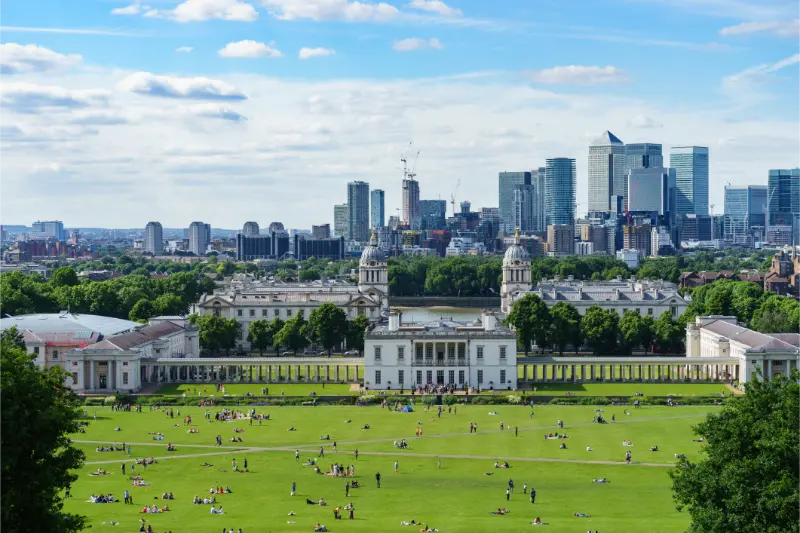
    Canary Wharf from Greenwich Park London

    Families can use the museum as a reset between outdoor sections. Adults who are not maritime specialists should resist trying to read every label; choose one or two galleries and preserve energy for the park. Greenwich works best as a varied day rather than a museum marathon.

    Greenwich Park: climb beyond the Observatory viewpoint

    The climb through Greenwich Park to the Royal Observatory is short but noticeable, especially after a long morning. The reward is one of London’s most recognisable skyline views. The Royal Parks also highlights One Tree Hill as a quieter viewpoint within the park, which is useful if the main terrace is packed.

    The park is more than a viewpoint. It contains historic avenues, gardens, old trees and traces of earlier occupation. If the weather is good, give it at least an hour beyond the standard photo. This is where Greenwich stops feeling like a bundle of attractions and starts feeling like a destination.

    Royal Observatory and the Prime Meridian: understand what you are paying for

    The famous Prime Meridian runs through the Royal Observatory site, where the history of longitude, navigation and timekeeping is explained. The paid Observatory visit is valuable if those subjects interest you; the attraction is not simply the act of placing one foot on either side of a line.

    If you are travelling with children, the science and navigation story often works better when you frame it around a question: how did sailors know where they were? Why does the world need standard time? That turns a photo stop into a memorable concept.

    Greenwich Market and where to eat

    Greenwich Market is convenient because it sits between the river and park route. It combines food and retail traders, and the surrounding streets add cafés and pubs. It can become very busy at weekends, so treat it as one option rather than the only possible lunch stop.

    If the market is packed, walk another few minutes before deciding. A quieter meal can be worth more than eating standing up simply because a stall appears in every online guide. For market comparisons across the city, see our London markets guide. For Greenwich itself, the dedicated Cutty Sark guide, Royal Observatory guide and London by boat guide make it easier to decide where to spend the limited hours.

    River Thames London

    A full-day Greenwich itinerary

    A balanced day is: arrive by river, see Cutty Sark, cross the Old Royal Naval College, visit either the National Maritime Museum or Queen’s House, have lunch, walk through Greenwich Park, then enter the Royal Observatory if it genuinely interests you. Finish by descending through the park and leaving by DLR or train.

    Using a different return mode is more than a transport trick. The DLR gives elevated views through Docklands and makes the contrast with historic Greenwich obvious. If you are already using contactless travel, our London transport guide explains fares and payment basics.

    • Morning: river arrival + maritime core.
    • Lunch: market or nearby streets.
    • Afternoon: park + Observatory.
    • Return: DLR or train for a different view of east London.

    Important 2026–2028 Royal Observatory changes

    Greenwich needs a date-specific plan because the Royal Observatory is in the middle of the First Light transformation. Royal Museums Greenwich states that the historic Observatory remains open until 2 November 2026. After that the site closes temporarily; the Meridian Courtyard is scheduled to reopen in summer 2027, while completion of the wider transformation is planned for spring 2028. The Peter Harrison Planetarium and Astronomy Centre are already closed as part of the works.

    If you are visiting before 2 November 2026, the classic sequence—park, Prime Meridian, Flamsteed House and the hilltop view—still makes sense, subject to day-specific closures. If you are visiting during the temporary closure, do not cancel Greenwich. Build the day around Cutty Sark, the Old Royal Naval College, National Maritime Museum, Queen’s House, Greenwich Market and the park itself. Royal Museums Greenwich is also moving astronomy programming into the National Maritime Museum during the project.

    A route that still works during the transformation

    Arrive by river if the timetable and weather cooperate, because the approach explains Greenwich’s relationship with the Thames. Visit Cutty Sark early if it is a priority, cross the naval-college grounds, choose one free museum, then have lunch before walking uphill through Greenwich Park. The skyline viewpoint remains valuable even when part of the Observatory experience is unavailable. Return by DLR or rail so the journey back shows you Docklands from a completely different angle.

    If you prefer a guided day or want transport bundled with an activity, compare Greenwich and Thames experiences on GetYourGuide. Whatever you choose, check the official First Light project page shortly before travelling because phased access will continue to change.

    Which Greenwich museum should you choose?

    If time is limited, choose according to interest rather than proximity. The National Maritime Museum gives the broadest maritime story and is the easiest free anchor for families; the Queen’s House is smaller, calmer and more art-focused; Cutty Sark is the most tactile ticketed experience. During the Royal Observatory transformation, this choice matters even more because the lower part of Greenwich can easily fill half a day without climbing the hill. A museum plus the park is usually more satisfying than trying to rush every site.

    Frequently asked questions

    Is Greenwich a day trip from London?

    Greenwich is part of London, not a separate day trip. It is easy to reach by river, DLR or train and fits naturally into a London itinerary.

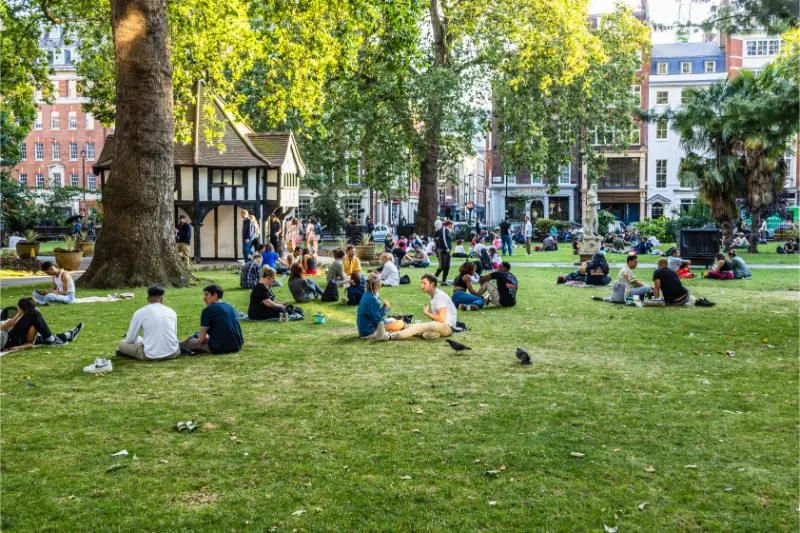
    People Relaxing in A London Park

    Is Greenwich worth visiting on a first trip?

    Yes if you have at least four days or strong interest in maritime history, views or parks. On a very short first visit, prioritise central essentials first.

    What is free in Greenwich?

    Walking the historic area and park is free, and major museum options such as the National Maritime Museum and Queen’s House have free general admission, while attractions such as the Royal Observatory and Cutty Sark are ticketed.

    How long does Greenwich take?

    Half a day covers the highlights quickly; a full day is far more comfortable if you want museums, the park and a paid attraction.

    Official information and final planning note

    For details that can change — opening times, temporary closures, booking rules, access arrangements and special events — check the official pages before travelling: Royal Museums Greenwich, Greenwich Park – The Royal Parks.

    Greenwich remains one of London’s strongest full-day districts even while the Observatory changes. Its value comes from the river, maritime collections, park, architecture and skyline working together, not from a single Meridian photograph.

    Plan Greenwich’s two headline paid attractions

    If you want to go beyond the free museums and park, read our dedicated Cutty Sark guide and the date-sensitive Royal Observatory Greenwich guide, which explains the 2026–28 First Light closure and reopening phases.

    Explore the modern Docklands nearby

    For a completely different east-London landscape, continue with our Canary Wharf and Docklands guide.

  • Soho London: A Street-by-Street Guide to Food, Music and Nightlife

    Soho London: A Street-by-Street Guide to Food, Music and Nightlife

    Soho is one of the hardest London neighbourhoods to explain with a list because its value lies in the streets between the named attractions. It is compact, busy and layered: music history beside fashionable restaurants, old pubs beside cocktail bars, theatres beside record shops, Chinatown beside Georgian squares, and LGBTQ+ history woven through the area rather than confined to one venue. The best first visit is a slow walk with a few anchors, not a race between famous addresses.

    Best forFood, nightlife, music, theatre, street life, repeat visits
    Minimum time2–3 hours; longer for dinner or nightlife
    Useful stationsTottenham Court Road, Piccadilly Circus, Leicester Square, Oxford Circus
    Best tipExplore by small streets; the neighbourhood is too compact to justify Tube hops

    Define Soho loosely and walk it as a grid

    Soho has no turnstile or single official entrance. For practical sightseeing, think of Oxford Street to the north, Regent Street to the west, Charing Cross Road to the east and Shaftesbury Avenue/Chinatown to the south. Within that box, the character changes every few minutes. This is why a street-by-street approach works better than asking for the one best attraction.

    Start by choosing a diagonal through the district rather than walking only the famous retail streets. Dean Street, Frith Street, Greek Street, Berwick Street and Old Compton Street reveal more of Soho’s personality than a quick pass along its edges. When a lane looks interesting, take it. The neighbourhood is small enough that getting slightly lost is usually an advantage.

    Soho Square gives the area a centre

    Soho Square is useful as a pause point and as a way to understand the district’s older urban form. Around it are offices, media buildings, historic facades and routes toward Oxford Street, Charing Cross Road and the heart of Soho. It is not one of London’s grandest squares, but that is precisely why it works: it feels like a neighbourhood space rather than a ceremonial one.

    If your trip is museum-heavy, Soho Square can also act as the transition between the British Museum/Bloomsbury and the West End. Walk south from Bloomsbury instead of taking the Tube one stop; the shift in street life is part of the experience.

    Music history is everywhere, but avoid turning it into a scavenger hunt

    Soho is deeply connected to British popular music and nightlife. Denmark Street on the eastern edge, jazz clubs, former studios, record shops and famous venues all contribute to that story. Some legendary locations have changed use or disappeared, so be cautious with old online lists that imply every 1960s address is still functioning in the same way.

    A more satisfying approach is to choose one living institution — perhaps a jazz venue, record shop or concert — and let historic locations add context around it. Music culture survives through active places, not only plaques. If you are planning an evening, check current programmes rather than relying on evergreen recommendation posts.

    Carnaby is more interesting when connected to side streets

    Carnaby remains one of Soho’s most recognisable shopping areas and carries strong associations with 1960s fashion and youth culture. Today it is highly commercial, but the surrounding pedestrian streets and Kingly Court create an easy place to wander, eat and people-watch.

    Borough Market Glass Pavilion Southwark London

    Do not judge the whole of Soho by Carnaby alone. Walk east through smaller lanes, then south toward Old Compton Street or Chinatown. The contrast between polished retail and dense independent food and nightlife is one of the reasons the area remains compelling.

    Chinatown and Soho should be experienced together

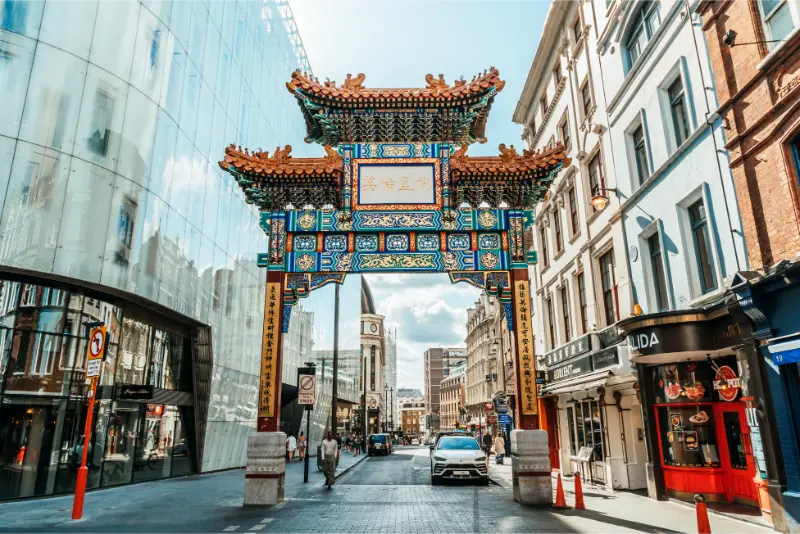
    London’s Chinatown sits on Soho’s southern edge around Gerrard Street and the surrounding roads. The visual gateway and lanterns attract photographs, but the more useful reason to visit is food. Restaurants, bakeries, dessert shops and supermarkets give the area a different rhythm from the theatre streets next door.

    Meal quality and queue length are not always the same thing. If one doorway has a viral line, walk another block and compare menus. Soho rewards curiosity. The neighbourhood has food from far beyond Britain, and that is not a contradiction to a London experience; it is one of the most London things about the city.

    LGBTQ+ Soho: history and current nightlife overlap

    Soho has long been associated with London’s LGBTQ+ social and nightlife history, particularly around Old Compton Street and nearby lanes. Today the area includes bars, clubs and community landmarks, but it is also a mixed central neighbourhood used by visitors of every background.

    If you want to understand that history rather than simply visit a bar, look for guided walks, archives, plaques and cultural resources with a documented basis. Avoid treating living communities as a tourist attraction. The strongest travel writing recognises history while respecting that Soho is still a working social district.

    Eating in Soho: choose a cuisine, not a “best restaurant” list

    Soho has too many restaurants for one permanent ranking to remain useful. Openings, chefs and concepts change quickly. A better strategy is to decide what kind of meal you need: fast lunch, pre-theatre dinner, late-night noodles, modern British, small plates, bakery, vegetarian or something specific from Chinatown. Then compare current menus and availability within a few streets.

    This method keeps your day geographically sensible. It also protects you from crossing London for a restaurant whose main attraction is online visibility. For broader ideas, use our London food guide and London markets guide.

    Camden Lock Market Aerial View London

    A first-time Soho route that actually works

    Begin at Tottenham Court Road and walk down Denmark Street, then cut west toward Soho Square. Continue through Greek Street and Frith Street, explore Old Compton Street, pass into Chinatown, then loop west toward Carnaby and finish near Regent Street or Piccadilly Circus. That gives you music, food, nightlife history and retail without repeating streets.

    For an evening version, reverse the route and end deeper inside Soho after dinner. For a quieter daytime version, start before lunch and continue into Covent Garden afterward. Our Covent Garden guide and walking routes fit naturally with this plan.

    How to use Soho at different times of day

    Soho changes more than most central neighbourhoods between morning and night. Before lunch, it is easier to notice record shops, architecture, independent businesses and the smaller streets around Berwick Street. Late afternoon brings after-work energy. After dark, restaurants, bars, theatres and music venues become the main reason to stay. Decide which version you want before building the route; arriving at 10am for nightlife atmosphere or at 11pm for quiet heritage walking will obviously disappoint.

    A useful daytime line runs from Oxford Street through Soho Square and Old Compton Street toward Chinatown, then west toward Carnaby and Kingly Street. In the evening, shorten the route and spend more time inside places rather than walking every street. If live music matters, check venue calendars instead of relying on a historical reputation: famous music addresses do not necessarily host the kind of performance you expect every night.

    Food, nightlife and the journey home

    Soho is a poor place to improvise every decision at 8pm on a Friday. Save one restaurant option, one backup and the nearest useful station for your hotel. Chinatown, Covent Garden and the wider West End are close enough to combine on foot, while our London nightlife guide is better for comparing Soho with Shoreditch, Camden and other evening areas.

    For visitors who want context around food, music or LGBTQ+ history, a specialist small-group walk can add value. You can compare Soho tours on GetYourGuide. Late at night, use the same normal city precautions you would in any busy entertainment district: secure your phone, know the route back and do not follow an unofficial transport offer.

    Soho beyond the obvious streets

    One useful way to avoid making Soho feel interchangeable with the rest of the West End is to notice its micro-areas. Carnaby and Kingly Street lean toward shopping and polished dining; Old Compton Street carries a different nightlife and LGBTQ+ history; Berwick Street has its own market and music associations; Soho Square gives you a rare patch of green in the middle of the district. You do not need to ‘complete’ all of them. Pick two or three according to the time of day and the reason you came.

    Frequently asked questions

    Is Soho safe for tourists?

    Soho is a busy central entertainment district. Use normal big-city awareness, especially late at night: watch belongings, plan the journey back and avoid poorly lit shortcuts if you are uncomfortable.

    Gerrard Street Chinatown London

    Is Soho worth visiting during the day?

    Yes. Daytime is better for architecture, shops, cafés, music history and quieter walking. The atmosphere changes significantly after work and before theatre performances.

    How much time do you need?

    Two to three hours is enough for a first walk. Add dinner, theatre or live music and Soho can easily become your entire evening.

    Is Chinatown part of Soho?

    Chinatown sits immediately beside and partly within the wider Soho/West End area in practical visitor terms. They are easy to explore together on foot.

    For the neighbouring streets around Gerrard Street and the cinema district, continue with our Chinatown and Leicester Square guide, which is designed to connect naturally with Soho and the West End.

    Official information and final planning note

    For details that can change — opening times, temporary closures, booking rules, access arrangements and special events — check the official pages before travelling: Visit London – Soho and Chinatown.

    Soho rewards travellers who choose a time of day and a reason to be there. Walk it slowly in daylight for detail, or stay into the evening for food, music and nightlife—trying to do both at once often means seeing neither version properly.

    Continue into Chinatown and Leicester Square

    Soho flows directly into the West End’s East Asian food district. Our Chinatown and Leicester Square guide explains timing, restaurant strategy and how to connect the area with theatre.

  • Covent Garden London: What to See Beyond the Piazza

    Covent Garden London: What to See Beyond the Piazza

    Covent Garden is easy to dismiss as a touristy square with street performers, but that misses why the area works so well. Within a few blocks you can move from a 19th-century market building to opera, small lanes, theatres, historic pubs, independent shops and some of central London’s best pedestrian connections. The smartest way to visit is not to spend two hours circling the Piazza; it is to use Covent Garden as the centre of a wider walk through Seven Dials, Neal’s Yard, the Strand and Soho.

    Best forFirst-time visitors, theatre, food, shopping, evening atmosphere
    Minimum time2 hours; half a day with Seven Dials and Soho
    Nearest stationsCovent Garden, Leicester Square, Charing Cross, Holborn
    Best tipWalk in from another station at busy times rather than treating the Tube stop as essential

    Understand what the Market Building actually is

    Covent Garden began as the garden of Westminster Abbey’s convent, and the square later developed into London’s major fruit and vegetable market. The present market building dates from the 19th-century redevelopment of the site. Today the function is completely different: the arcades contain shops, restaurants and small stalls, while the Piazza acts as a stage for public life and licensed street performance.

    That history matters because it explains the architecture. Look at the relationship between the colonnades, open square and surrounding terraces rather than seeing the market only as a shopping centre. The official Covent Garden history records the market’s long evolution, including the creation of the formal market building in the 1820s. The old wholesale fruit and vegetable market itself eventually moved to Nine Elms in the 1970s.

    Visit early for architecture, later for atmosphere

    Covent Garden changes dramatically through the day. In the morning, deliveries are ending, performers are fewer and the Piazza is easier to photograph. Around lunch the market fills, and by late afternoon the combination of shoppers, theatre crowds and dinner reservations creates the energy most visitors associate with the area.

    There is no single best time. Choose according to what you want. Early is best if you dislike crowds; midday is good if you want the market active; pre-theatre hours are best for atmosphere. If you are staying nearby, passing through twice at different times is often more satisfying than forcing a long visit at the busiest hour.

    Do not miss St Paul’s Church and the quieter edge of the Piazza

    St Paul’s Church, often called the Actors’ Church, sits on the western side of the Piazza. Its relationship with theatre history makes it a more meaningful stop than another souvenir shop. The churchyard behind it can also provide a calmer few minutes when the front of Covent Garden is crowded.

    This is a good example of how to use central London well: whenever a famous square feels overrun, look for the churchyard, side street or parallel lane. The city rarely becomes quiet all at once, but it changes quickly from block to block.

    Seven Dials is the natural next step

    From Covent Garden, walk northwest toward Seven Dials. The name comes from the seven streets radiating from the small central junction. It is not a monumental sight, but it is one of the most useful pedestrian nodes in the West End because it connects Covent Garden with Soho, St Giles and the theatre district.

    Covent Garden Christmas Decorations London

    Neal’s Yard is nearby and visually distinctive, but it is very small. Treat it as a five- or ten-minute detour rather than building an itinerary around it. The same principle applies to many social-media-famous London spots: their value is often greatest when folded into a larger walk.

    • Covent Garden Piazza → Seven Dials is an easy walk.
    • Neal’s Yard is a short detour, not a half-day attraction.
    • Continue west to Soho or north toward the British Museum.

    Theatre: the area makes sense before and after a show

    Covent Garden sits in the heart of London’s theatre district, with the Royal Opera House beside the Piazza and many West End theatres within walking distance. If you have tickets, arrive early enough to eat without watching the clock. Restaurants around the West End are accustomed to pre-theatre dining, but reservation pressure can be intense on popular nights.

    After a show, resist the instinct to take the Tube for a journey that may be shorter on foot. Leicester Square, Soho and Trafalgar Square are close. Night walking through well-trafficked central streets can be one of the pleasures of a London evening, provided you use normal city awareness and choose routes that fit your destination.

    Shopping without spending the entire visit inside chains

    The market and surrounding streets mix major brands with smaller businesses. If shopping is part of your trip, give yourself a goal: beauty, stationery, British design, books, clothing or food. Otherwise the area can absorb time without leaving much memory beyond browsing.

    For independent-feeling streets, explore around Seven Dials and side roads toward Soho. For flagship retail, Regent Street and Oxford Street are not far. The best approach is to make Covent Garden one piece of a shopping walk rather than repeatedly crossing central London between stores.

    Where to eat and drink

    Covent Garden has an enormous range of food, from quick counters to destination restaurants. The challenge is not finding somewhere; it is choosing without losing an hour to indecision. If you have a theatre booking, prioritise reliability and walking distance. If you are exploring casually, move toward Seven Dials, Chinatown or Soho and choose based on what looks appealing rather than what has the longest social-media queue.

    Historic pubs are scattered through the West End, and some are more rewarding for atmosphere than for food. If pub culture interests you, use our London pub guide. For broader food planning, see what to eat in London.

    West End London at Night

    A better two-to-four-hour route

    Start at Somerset House or the Strand, walk into Covent Garden through the eastern side of the Piazza, explore the Market Building, pass St Paul’s Church, then continue to Seven Dials and Neal’s Yard. From there choose one direction: west into Soho, north toward Bloomsbury and the British Museum, or south through Leicester Square to Trafalgar Square.

    This route is stronger than arriving by Tube, circling the Piazza and leaving from the same station. It turns Covent Garden into a hinge between central London neighbourhoods. For more route ideas, see our best walks in London and neighbourhood guide.

    How Covent Garden fits into a smarter central-London day

    Covent Garden works best as connective tissue between bigger anchors. If you begin at the British Museum, walk south through Seven Dials and arrive before lunch. If the National Gallery is your morning priority, cross from Trafalgar Square through the Strand and use Covent Garden for lunch, shopping and theatre atmosphere. In the evening, the neighbourhood becomes a natural pre-show zone for the West End. This is more efficient than treating the Piazza as a destination that requires a separate Tube journey.

    Do not limit the area to the Market Building. Neal Street, Monmouth Street, Seven Dials and the streets toward Drury Lane change the texture quickly. Neal’s Yard is photogenic but tiny; visit because it is on your route, not because social media makes it look like a half-day attraction. If street performers are part of the appeal, give yourself time to stop rather than blocking circulation for one photograph.

    What changes the experience most

    Timing matters. Late morning lets you see shops and the market area fully awake without immediately colliding with theatre crowds. Late afternoon is livelier and works well before dinner or a performance. Covent Garden Underground station is convenient but can feel constrained at busy times; Leicester Square, Holborn and Charing Cross may fit your route better. Walking in from a neighbouring district is often the nicest arrival.

    If you want a guided layer rather than independent browsing, compare Covent Garden walking and food experiences on GetYourGuide. The useful tours are the ones that explain theatre history, food or nearby streets—not a generic circuit that simply repeats what you can read on the plaques.

    Portobello Road Market Notting Hill London

    Frequently asked questions

    Is Covent Garden Market free to enter?

    Yes, walking around the Piazza and Market Building is free. You pay only for shopping, food, performances that require tickets and other individual activities.

    How long should you spend in Covent Garden?

    Around two hours is enough for the Piazza, Market Building and nearby lanes. Half a day works better if you add Seven Dials, a meal, shopping or a theatre-related stop.

    Is Covent Garden worth visiting if you do not like shopping?

    Yes. Its architecture, street life, theatre connections and location between Soho, the Strand and Bloomsbury make it useful even without shopping.

    Which station is best?

    Covent Garden is closest, but Leicester Square, Charing Cross and Holborn can be practical depending on your route. Walking in often avoids unnecessary transfers.

    Official information and final planning note

    For details that can change — opening times, temporary closures, booking rules, access arrangements and special events — check the official pages before travelling: Covent Garden official site.

    Covent Garden is most memorable when it becomes part of a walk rather than a single piazza stop. Let theatre, food, Seven Dials and the neighbouring West End streets determine how long you stay.

    Nearby cultural stops include Somerset House and the Courtauld Gallery, both easy to combine with Covent Garden on foot.

  • Westminster London: A Smart Walking Guide to the Ceremonial Heart

    Westminster London: A Smart Walking Guide to the Ceremonial Heart

    Westminster is where many first-time visitors meet London: Parliament, Big Ben, Westminster Abbey, Whitehall, St James’s Park and Buckingham Palace all sit within a surprisingly compact area. The mistake is treating these landmarks as isolated photo stops. Westminster becomes much more rewarding when you understand the sequence between them, leave time for interiors, and use the smaller streets, gardens and riverfront as part of the experience. This guide is built as a realistic walking day rather than a checklist. If this is your first trip, pair it with our first-time London guide and three-day London itinerary.

    Best forFirst visits, royal and political history, architecture, photography
    Minimum time3–4 hours for exteriors; most of a day with major interiors
    Useful stationsWestminster, St James’s Park, Charing Cross, Victoria
    Best approachWalk the area in one direction instead of repeatedly using the Tube

    Start at Westminster Bridge, not inside the Tube maze

    Arriving at Westminster Underground is efficient, but give yourself a moment to get oriented before charging toward the first queue. Step toward the river and look across the Thames. From the south side of Westminster Bridge you get the classic view back to the Palace of Westminster and the Elizabeth Tower, while from the north bank you can understand how Parliament, the Abbey and Whitehall fit together. The point of starting here is geographical: once the river is behind you, the rest of the day unfolds naturally west and north.

    Big Ben is technically the name of the Great Bell, although the nickname is widely used for the clock tower itself. You do not need to correct everyone around you; what matters for a useful visit is recognising that the Palace of Westminster is a working parliamentary complex, not simply a backdrop. Security arrangements, access to debates and tours depend on parliamentary business, so do not build a tight day around assumptions about entry.

    • Walk onto the bridge for wider views, then return toward Parliament Square.
    • Allow extra time around demonstrations, ceremonies or road closures.
    • Early morning gives cleaner sightlines; dusk gives the most atmospheric river views.

    Westminster Abbey deserves more than a quick exterior photo

    Westminster Abbey has been the coronation church since 1066 and is the burial or memorial place of major figures from British history. That density is exactly why a rushed visit can feel overwhelming. Instead of trying to absorb every monument, choose a few themes before entering: monarchy, writers, scientists, military history or medieval architecture. The Abbey itself says most visitors spend around one and a half to two hours, with longer needed if you add the Galleries and Cloisters.

    Because it is a working church, schedules can change for services and special occasions. Sunday is primarily for worship rather than ordinary sightseeing. Advance booking is useful in busy periods, and the multimedia guide helps make sense of spaces that otherwise become a blur of names and stone. If you only have one paid interior in Westminster, this is one of the strongest choices because the building connects royal, religious and national history in one place.

    Parliament Square to Whitehall: read the city between the icons

    From Parliament Square, walk north along Whitehall rather than disappearing underground. Within a short distance you pass the government quarter, the Cenotaph, Horse Guards and entrances toward Downing Street. Access and sightlines around official buildings can be restricted, but the walk itself is valuable because it shows how tightly ceremonial London and working government overlap.

    A useful detour is through Horse Guards Parade toward St James’s Park. This avoids returning along the same pavement and immediately changes the atmosphere from formal avenue to greenery and water. If Churchill War Rooms is on your list, schedule it as a timed anchor rather than trying to squeeze it in spontaneously between the Abbey and the Palace. The underground complex is more absorbing than its modest entrance suggests.

    Houses of Parliament and Big Ben London
    • Whitehall is best appreciated on foot.
    • Do not block gates or security areas for photographs.
    • Keep one timed attraction in this zone rather than stacking several.

    St James’s Park is part of the route, not dead time

    St James’s Park is the most elegant way to connect Westminster with Buckingham Palace. Take the path around the lake instead of walking only along the edge of The Mall. The bridges and waterside paths give changing views toward government buildings and the Palace, and the park provides a natural break after the heavier history of Parliament and the Abbey.

    If the day is crowded, this is also where to slow the pace. London itineraries often fail because every minute is allocated to an attraction. Twenty unplanned minutes on a bench can make the second half of the day better. Families especially benefit from treating the park as a destination rather than a corridor. For more green-space ideas, see our London neighbourhood guide.

    Buckingham Palace: decide whether you want the building, the ceremony or the interior

    Many visitors arrive at Buckingham Palace without deciding what they actually want to experience. Seeing the façade and Victoria Memorial is free and possible year-round. Watching a guard ceremony requires checking the official schedule and accepting that the best-known viewpoints can become crowded. Touring the State Rooms is different again: it is seasonal for general visitors and needs far more time than a photo stop.

    If the State Rooms are open during your dates, avoid scheduling Westminster Abbey, Churchill War Rooms and Buckingham Palace interiors all in one compressed window. That looks efficient on a map but feels like a sequence of queues and security checks. Our separate Buckingham Palace guide explains what can actually be visited and how to combine the Palace with the Royal Mews, St James’s or Green Park.

    The quieter Westminster most itineraries miss

    Westminster has several calm pockets within minutes of the headline sights. Dean’s Yard gives a different perspective on the Abbey precinct. Victoria Tower Gardens stretches south from Parliament beside the Thames and is useful when Parliament Square feels congested. The streets around St James’s contain old clubs, shops and small passages that feel far removed from coach-tour London even though they are close to The Mall.

    These are not secret places, and they should not be marketed as if nobody knows them. Their value is practical: they create breathing space and reveal that central London is layered. A good day in Westminster alternates grand set pieces with smaller transitions instead of treating every street between attractions as wasted time.

    Buckingham Palace and Victoria Memorial at Dusk London

    Where to eat without derailing the day

    The streets immediately around the biggest landmarks are convenient but not always the most interesting place to spend your food budget. If lunch is purely functional, eat near your current attraction and keep moving. If food matters, walk toward Victoria, St James’s, Soho or Covent Garden rather than crossing London for a restaurant saved from social media.

    For an English pub stop, remember that central pubs vary from historic rooms to modern chains. Our historic London pubs and pub etiquette guide explains ordering, tipping expectations and how to distinguish a worthwhile pub stop from a generic one. The main rule is simple: choose food and drink that fit the geography of your day.

    A realistic Westminster route for one day

    A strong full-day sequence is Westminster Bridge and Parliament Square in the morning, Westminster Abbey as your main interior, Whitehall and Horse Guards on foot, lunch, St James’s Park, then Buckingham Palace and Green Park. If you still have energy, continue through St James’s to Piccadilly and finish in Soho or Covent Garden for the evening.

    That route works because it moves in one direction and changes character several times. It also gives you escape options: skip an interior if the weather is exceptional, add Churchill War Rooms if rain arrives, or finish earlier if jet lag catches up. London rewards flexible structure far more than rigid minute-by-minute planning.

    • Morning: Parliament Square + Westminster Abbey.
    • Midday: Whitehall + Horse Guards + lunch.
    • Afternoon: St James’s Park + Buckingham Palace.
    • Evening: walk toward Piccadilly, Soho or Covent Garden.

    Guided Westminster: when it adds value

    Westminster is easy to walk independently, but a specialist guide can help with parliamentary, royal and church history. compare Westminster tours on GetYourGuide; check whether Abbey admission is actually included or whether the product is an exterior walk only.

    Frequently asked questions

    How long do you need in Westminster?

    Allow at least three to four hours for a meaningful exterior-focused visit. With Westminster Abbey or Churchill War Rooms, half a day is more realistic; with multiple interiors, make Westminster the main focus of the day.

    Is Westminster walkable?

    Yes. The key sights are close enough that walking is usually better than taking the Tube between them. Comfortable shoes matter because security queues and large interiors add standing time.

    Canary Wharf Skyline from River Thames London

    What is the best time of day for Westminster?

    Early morning is calmer for landmark photography. Late afternoon and dusk are excellent for the river and illuminated buildings. Interior opening times should determine the middle of your day.

    Can you visit Westminster Abbey on Sunday?

    The Abbey is open for worship on Sundays, but ordinary tourist visiting operates differently. Check the official schedule if your trip falls on a Sunday.

    Official information and final planning note

    For details that can change — opening times, temporary closures, booking rules, access arrangements and special events — check the official pages before travelling: Westminster Abbey, Visit London – Westminster.

    Westminster works best when ceremony and ordinary city life share the same route. Give the Abbey or Churchill War Rooms proper time, walk the public spaces between them and use St James’s Park as breathing room rather than treating every royal or political building as another timed stop. The area is compact enough that a thoughtful walking sequence is almost always better than jumping between stations.

    If your dates fall in June, check our Trooping the Colour guide: parade-day security and crowds can change how Westminster, Horse Guards and The Mall work.

    For an interior visit to the political heart of Westminster, see our Houses of Parliament tour guide.