
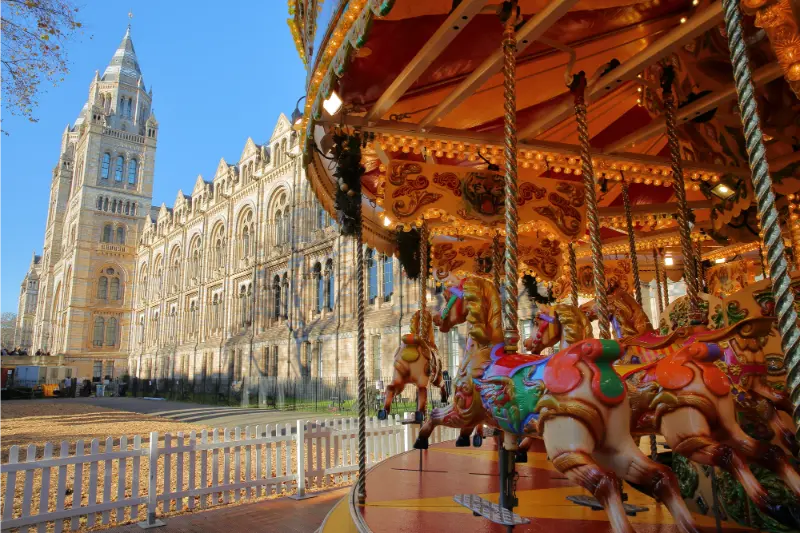
London has an exceptional museum scene for families, but “best museum for kids” is too broad to be useful unless you match the museum to the child. A dinosaur-obsessed six-year-old, a transport-mad toddler and a design-focused teenager may all have excellent days in London, but probably not in the same gallery.
The advantage is that many major collections are free to enter, which makes short visits possible. You do not need to force three hours out of a museum just because you paid for admission. The harder question is where to spend limited family energy, especially on a first trip.
Quick answer: who is this guide for?
For a first family visit, the Natural History Museum, Science Museum and London Transport Museum are the safest all-round choices; Young V&A is especially strong for younger creative children, while Greenwich museums work well when you want indoor learning plus outdoor space.
Before building the day, compare this guide with our Natural History Museum route, our Science Museum guide, our London Transport Museum guide and the main London-with-kids guide. These pages solve different parts of the same family-planning problem, so using them together usually produces a calmer itinerary.
Quick comparison by child type
| Museum | Best for | Typical family strength | Main caution |
|---|---|---|---|
| Natural History Museum | Dinosaurs, animals, ages 4–12 | Immediate visual impact and free core galleries | Very busy at peak times |
| Science Museum | Hands-on science, ages 6–14 | Interactive galleries and technology | Paid experiences can add up |
| London Transport Museum | Vehicles, ages 2–10 | Play and recognisable London transport | Adult admission is paid |
| Young V&A | Creative play, ages 2–12 | Designed around children and families | Bethnal Green is outside the classic first-day circuit |
| National Maritime Museum | Ships, exploration, Greenwich day | Easy to combine with park and river | Best as part of a wider Greenwich plan |
| Horniman Museum | Animals, music, gardens | Local, varied and less central | Journey is longer from West End hotels |
Natural History Museum: best for instant excitement
The Natural History Museum succeeds because children understand its themes immediately: dinosaurs, giant animals, volcanoes, evolution and the natural world. You can build a two-hour visit around a few family favourites rather than trying to cover every gallery. This is especially important at weekends and school holidays, when movement through popular spaces can become tiring.
Families who love dinosaurs should start with them rather than saving the favourite for the end. After that, choose one contrasting area and finish while attention is still strong. The museum itself recommends family activities and self-guided options, which is useful when you want a route rather than an open-ended wander.
Science Museum: best for children who want to do things
The Science Museum is often the better choice for children who become restless when a museum is mostly display cases. Space, engineering, communications, medicine and technology provide variety, while interactive experiences can turn abstract ideas into something physical. Some headline experiences are ticketed even though general museum admission is free, so decide in advance whether you are paying for an add-on or using the free galleries.
Wonderlab is the obvious interactive draw for many families, but the museum also works without it. Older children may prefer technology, gaming or engineering galleries. The key is to match the visit to interest rather than treat the museum as a single linear attraction.
London Transport Museum: best for vehicles and younger children
Covent Garden location is a major advantage: this museum can sit inside a central-London day without a long detour. Historic buses, Underground trains and the evolution of the network make the content recognisably “London,” while play elements are particularly useful for younger visitors who need to touch, pretend and move.
Because adult admission is paid, I would not use it as a rushed 45-minute filler. Give children time to engage with the interactive sections, then combine the visit with Covent Garden rather than adding another major museum immediately afterwards.
Young V&A: best for creativity and child-led exploration
Young V&A in Bethnal Green is built around children, design and imagination rather than adapting an adult museum for family use. That changes the feel of the visit. Creative stations, objects and playful spaces work particularly well for children who prefer making, imagining and testing ideas to reading long labels.
General admission is free, and the location also gives families a reason to explore East London beyond the standard Westminster–South Kensington route. For a second or third London visit, that can make the day feel fresher.
Greenwich museums: best for a whole family day
The National Maritime Museum, Cutty Sark and Royal Observatory sit within one of London’s strongest family day-out areas. The museum advantage here is context: you can move between indoor collections, the river and Greenwich Park without returning to the Tube between every activity.

You do not need all three paid or formal attractions. Choose the one that matches the child, then let Greenwich itself provide the rest of the day. The park and river help prevent museum fatigue.
Horniman Museum: best for a local, mixed indoor-outdoor day
The Horniman in Forest Hill is an excellent example of a museum that can work because it is not in the centre. Its museum collections, gardens, animal elements and family spaces allow children to switch modes during the same visit. Much of the museum and gardens can be visited free, while some experiences such as the Aquarium and Butterfly House require tickets.
For families staying in south or east London, the Horniman can be more practical than crossing the city for another famous institution. It also pairs naturally with a picnic or time in the gardens.
How long should you spend?
- 60–90 minutes: one favourite gallery plus a snack; excellent for toddlers or as part of a wider day.
- 2–3 hours: the sweet spot for most school-age children in a large museum.
- Half day: suitable when interactive galleries, workshops or paid experiences are the main event.
- Full day: better for museum-plus-park areas such as Greenwich or the Horniman than for remaining indoors continuously.
Leaving while children are still interested is usually better than extracting every possible minute from free admission. London’s museums are valuable partly because you can return or choose another one later.
Ages matter more than rankings
Toddlers respond to movement, vehicles, colour and spaces designed at their scale. Primary-school children often thrive on dinosaurs, experiments and clear stories. Teenagers may prefer specialist galleries, design, technology, fashion, war history or social history depending on personality. A family ranking that ignores age is therefore misleading.
If siblings have very different interests, alternate who chooses the anchor museum and use a park, market or river journey as common ground afterwards.
My practical family strategy
Plan around family energy, not a sightseeing scorecard. Keep one element optional, protect time for food and toilets, and stop before the day becomes a forced march.

Related family guides
- Young V&A with kids
- Postal Museum and Mail Rail
- Horniman Museum and Gardens
Museum fatigue: the warning signs
Museum fatigue usually appears before a child says “I am tired.” They rush past displays, ask repeatedly about food, sit on every bench or begin touching things simply to create stimulation. Treat those signals as useful information. Move to an interactive area, take a snack break or leave. London has so many collections that protecting enthusiasm for tomorrow is more valuable than finishing one more gallery today.
How to prepare children before the visit
Show children two or three images from the museum website and let them choose one thing they want to find. A simple mission gives the visit structure without turning it into homework. For younger children, the mission might be “find the biggest dinosaur” or “ride in a red bus”; for older children it can be a specific invention, artwork or historical object. When they have found their thing, the rest of the museum feels like bonus exploration rather than an obligation.
One final planning detail
Families with neurodivergent children or sensory sensitivities should check each museum’s accessibility resources before travel. Many large institutions publish visual stories, quieter-session information or details about lighting and noise. The most famous museum is not always the best environment on the day. A smaller museum with predictable spaces may create a more successful visit, and that success matters more than the number of stars beside the attraction name.
Before the trip, save the address, nearest useful station and official visitor page for Best Museums in London for Kids. This small preparation avoids searching on a crowded pavement with children waiting. Also decide which part of the day you are willing to drop if transport, weather or energy changes. Families who identify the optional element in advance adapt much more calmly than those who treat every line of the itinerary as fixed.
A final family decision checklist for Best Museums in London for Kids
Before committing to best museums in London for kids, check four things together: the age and interests of your children, the journey from your accommodation, the likely energy level at that point in the trip and the weather or opening conditions for the day. A plan that looks excellent in isolation can become poor value when it requires an awkward cross-city transfer after a busy morning. I would rather simplify the route and give children enough time to enjoy the main experience than add another famous stop simply because it is nearby on a map.
Also decide in advance what you will drop if best museums in london for kids takes longer than expected. This single decision prevents the rest of the day from becoming a chain of delays. Keep food, toilets and a short rest close to the main route, save the official page and nearest useful station on your phone, and tell older children what the plan is so they can help with choices. The best family days in London usually feel flexible even when they were carefully prepared.