

The British Museum is free to enter for the permanent collection, enormous enough to overwhelm almost anyone, and much better when you arrive with a route. Trying to ‘see the museum’ in one visit is the wrong goal. A first-time visitor should aim to understand a few connected stories, see several world-famous objects, and leave before fatigue turns the final galleries into corridors. Two to three hours is a strong first visit; a Friday late opening can be useful if it matches your dates.
| Best for | World history, archaeology, ancient cultures, rainy days |
|---|---|
| Minimum time | 2 hours; 3 hours for a strong first visit |
| Nearest stations | Tottenham Court Road, Holborn, Russell Square, Goodge Street |
| Admission | Permanent collection free; advance free booking recommended |
Book the free entry slot if you know your date
The British Museum’s permanent collection has free admission, but the museum recommends advance booking. Walk-up entry can be available subject to capacity, which means a spontaneous visit is possible but not guaranteed in the same way on very busy days.
This is a good example of a London planning principle: free does not mean frictionless. Booking a free slot costs nothing and protects the rest of your day. Special exhibitions may require separate paid tickets and timed entry.
Begin in the Great Court and make a plan before moving
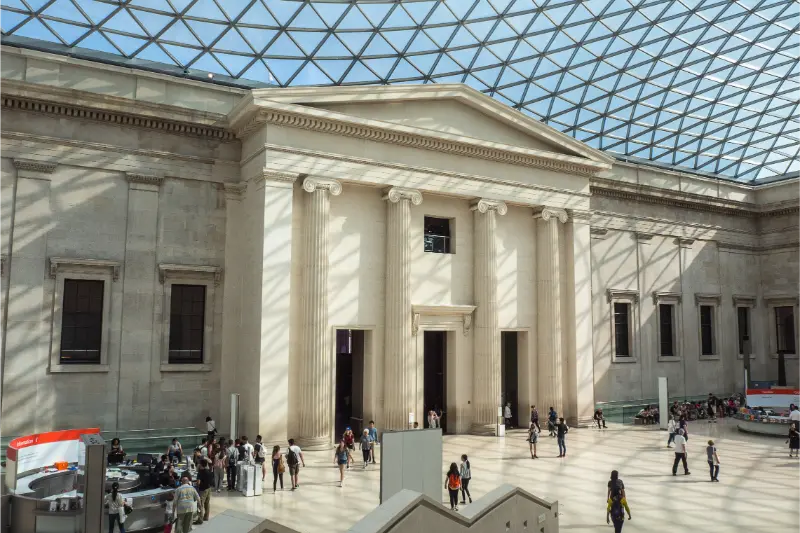
The Great Court is not just an entrance hall; it is a useful orientation space beneath the glass roof around the Reading Room. Take two minutes with the map before entering the galleries. Decide on a route based on themes rather than object fame alone.
If you arrive and immediately follow whichever crowd is moving fastest, you can spend an hour in ancient Egypt without realising you have skipped the parts that interested you most. Museum fatigue begins with indecision. A map is more valuable here than a list of twenty must-sees.
A strong two-to-three-hour first route
One effective first route starts with ancient Egypt and the Rosetta Stone, continues toward Assyria and the ancient Middle East, then moves to Greek and Roman galleries. From there, go upstairs for Sutton Hoo and medieval Europe, and finish with one gallery that reflects your personal interest — the Islamic world, clocks and watches, Japan or another region.
This is not an official compulsory route and gallery availability can change. The Museum itself warns that rooms may close at short notice. The purpose is to create a narrative arc and reduce backtracking. Check the current map before visiting.
- Anchor 1: Rosetta Stone and Egyptian sculpture.
- Anchor 2: Assyrian reliefs / ancient Middle East.
- Anchor 3: Greek and Roman world.
- Anchor 4: Sutton Hoo / medieval Europe.
- Final choice: one specialist gallery you genuinely care about.
The Rosetta Stone: stop for context, not only a photo
The Rosetta Stone is famous because the text appears in multiple scripts and was central to the decipherment of Egyptian hieroglyphs. The display is often crowded, so it helps to know why you are looking at it before joining the semicircle of phones.
Photograph it if you want, then step aside and read about the scripts and translation. The object becomes more meaningful as evidence of language, power and scholarship rather than merely one of the museum’s celebrity exhibits.
Egyptian mummies: expect density and crowds
The upper-floor Egyptian galleries are among the most popular sections. If mummies are a priority, visit earlier in your route rather than leaving them until you are exhausted. The display covers funerary practices, beliefs and daily life across long periods; it is easy to reduce the section to spectacle if you move too fast.
Families often spend longer here than expected. Build that into your timing and do not promise five other major galleries afterward. A museum visit with children works better when everyone chooses one object or story to remember.
The Parthenon sculptures and contested heritage
The Parthenon sculptures are among the museum’s most internationally debated holdings. Any useful guide should acknowledge that their ownership and requested return are contested, particularly by Greece. The museum presents its own position, while Greek authorities and the Acropolis Museum have long argued for reunification in Athens.
You do not need a travel article to decide the dispute for you. What matters for visiting is understanding that these are not culturally neutral display objects without a modern political history. Read the gallery interpretation and, if the issue interests you, compare primary institutional sources from both sides.
Sutton Hoo and British history: do not stop at the ancient Mediterranean
First-time visitors often spend so long in Egypt and Greece that they miss medieval and early English material. The Sutton Hoo gallery is an excellent counterbalance because it shows archaeology closer to home and connects objects with burial, status and early medieval society.
The Lewis Chessmen and other medieval objects nearby make this part of the museum surprisingly accessible even for visitors who normally think they prefer ancient history. Give yourself permission to leave one giant collection area before you have seen every case.
Friday late opening can transform the experience
The museum currently opens later on Fridays, which can be useful for travellers who want to combine Bloomsbury with Soho or Covent Garden. Late hours do not guarantee empty galleries, but they change the rhythm of the day and can free your prime daylight hours for outdoor sightseeing.
Check the official site because special events and closures can affect the schedule. If you visit late, plan dinner nearby instead of taking a long cross-city journey afterward. Soho, Covent Garden and Fitzrovia are all walkable depending on where you finish.
Combine the museum with Bloomsbury, not another mega-museum
After two or three hours inside, walk through Bloomsbury squares or continue south to Covent Garden and Soho. This creates contrast between collections and city life. Our Covent Garden guide and Soho guide are designed to connect naturally from the museum.
If rain continues, you can extend the visit or use our rainy-day London itinerary. Just remember that museum time is not automatically better because it is free; leave while you are still interested.
Use the British Museum’s current hours strategically
The museum is currently open daily from 10:00 to 17:00, with Friday opening until 20:30; advance booking of the free general-admission slot is recommended and helps guarantee entry during busy periods. Friday evening is particularly useful if your daytime schedule is crowded, but not every gallery necessarily remains open late. Check the museum’s live gallery-closure information before building a route around one specific room.
A focused first visit should have a theme rather than a floor-count target. Ancient Egypt, Greece and Rome, Mesopotamia, or a cross-cultural route built around objects that changed how people wrote, traded or worshipped will stay in your memory longer than racing through twenty rooms. If one gallery is unexpectedly closed, move to the next object on your theme instead of trying to redesign the whole visit in the Great Court.
When a tour adds value
The British Museum is free, but interpretation is the scarce resource. A specialist guide can be worthwhile if you want a coherent historical argument rather than a highlights checklist. Otherwise, use the museum map and its own audio resources, choose six to ten objects and stop before museum fatigue turns the final rooms into background scenery.
You can compare British Museum guided tours on GetYourGuide. If you visit independently, combine the museum with Bloomsbury, Covent Garden or Soho rather than immediately crossing London to another giant collection.

Entrances, bags and avoiding the first bottleneck
The museum can become busy around opening and during school-holiday periods, so the advantage of a booked free slot is predictability rather than paid priority access. Arrive with only the bag you need, follow the current entrance guidance and do not schedule another timed attraction immediately after a two-hour museum route. Gallery closures and security queues are normal operational realities in a building of this scale; a small time buffer keeps them from turning into stress.
Frequently asked questions
Is the British Museum really free?
General admission to the permanent collection is free. Special exhibitions and some events can require paid tickets.
Do you need to book?
Advance booking is recommended and useful during busy periods. Walk-up entry may be available subject to capacity.
How long should a first visit take?
Two to three hours is a strong first visit. A full day is possible for enthusiasts, but most travellers learn more by returning another time than by pushing through fatigue.
When is the British Museum open late?
The current published schedule includes Friday opening until 20:30, but always confirm the date-specific hours before visiting.
Official information and final planning note
For details that can change — opening times, temporary closures, booking rules, access arrangements and special events — check the official pages before travelling: British Museum – Plan your visit, British Museum map.
The British Museum becomes manageable as soon as you stop trying to “see the museum” and start following a question, period or set of objects. A shorter visit with a clear theme is often more memorable than an exhausted full-day sweep.
Do not leave Bloomsbury too quickly
After the museum, use our Bloomsbury neighbourhood guide for garden squares, bookshops and smaller museums nearby.