
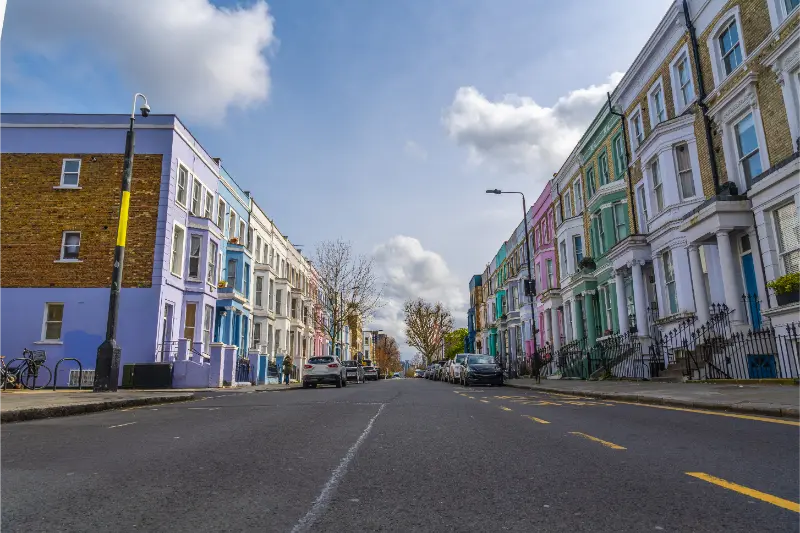
Notting Hill is often reduced to three images: pastel houses, the film, and Portobello Road Market. The real neighbourhood is more interesting. Caribbean history, postwar migration, activism, elegant terraces, mews, antique trading and one of Europe’s largest street festivals all overlap here. A respectful visit should go beyond photographing front doors and blocking residential steps. This guide builds a route that combines Portobello Road with the streets and history around it.
| Best for | Markets, architecture, photography, food, neighbourhood walking |
|---|---|
| Minimum time | 2–3 hours; half a day on a major market day |
| Useful stations | Notting Hill Gate, Ladbroke Grove, Westbourne Park |
| Best tip | Walk the market in one direction and exit from a different station |
Portobello Road changes by day and by section
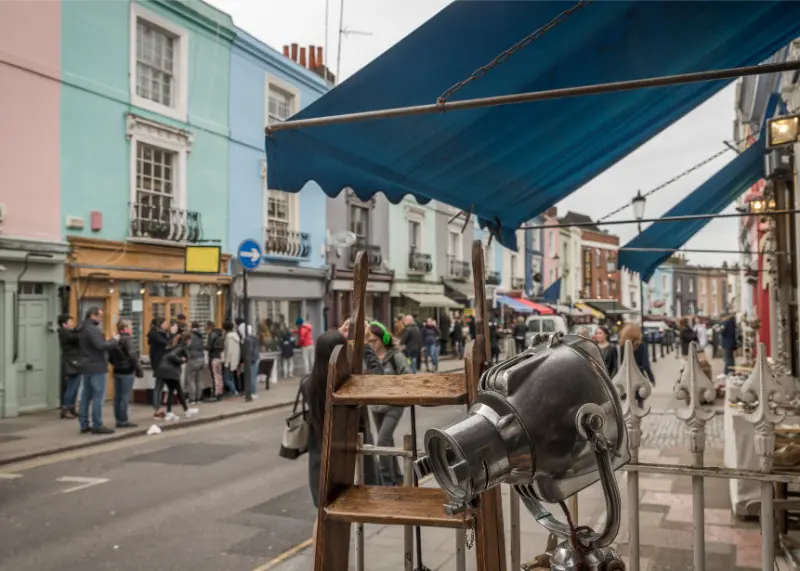
Portobello Road is not a single uniform market. The mix changes along the street and across the week, with antiques, food, produce, fashion and second-hand goods appearing in different concentrations. Visit London identifies Saturday as the main trading day, which also means the largest crowds. Friday can be a useful compromise for some visitors, while quieter weekdays show more of the neighbourhood itself.
If antiques are your priority, research the current trading pattern before going rather than assuming every day is identical. If your priority is photographs and architecture, an earlier weekday visit may suit you better than maximum market density.
Start south and walk north for a natural progression
A good first route begins near Notting Hill Gate, enters the southern end of Portobello Road and gradually moves north toward Ladbroke Grove. You begin among colourful facades and shops, then encounter denser market sections and eventually a more mixed urban landscape toward Golborne Road.
Walking one direction avoids unnecessary backtracking. It also makes public transport easier because Ladbroke Grove and Westbourne Park stations can serve as your exit. London neighbourhood days improve immediately when you stop insisting on returning to the station where you started.
Photography: be a visitor, not a nuisance
The coloured terraces and mews are photogenic, but many are private homes. Do not sit on steps, lean on doors, enter private mews or stage long photo sessions that obstruct residents. A beautiful street is not a film set simply because it appears on Instagram.
Wide street views usually tell the story better anyway. Look at architectural rhythm, railings, garden squares and how streets rise and curve. Notting Hill’s appeal comes from the whole urban landscape, not one turquoise door.
The neighbourhood’s Caribbean history matters
Notting Hill Carnival grew from the area’s Caribbean community and wider Black British cultural history. Understanding that context changes the neighbourhood from a pastel-photo destination into a place shaped by migration, racism, resistance, music and celebration. The Carnival takes place annually around the August bank holiday and dramatically changes transport, crowds and access across west London.
If your visit is outside Carnival, you can still approach the area with that history in mind. Food businesses, cultural references and local organisations form part of the story. Avoid presenting Carnival as a decorative event detached from the community that created it.
Golborne Road is worth continuing to
Many visitors turn around before reaching the northern end of Portobello Road. Continuing toward Golborne Road extends the walk into an area with Portuguese, North African and other influences alongside market activity. The streets feel less like the movie version of Notting Hill and more like lived-in west London.
This is often where the visit becomes more personal. You have left the best-known facades behind and are no longer walking only for a checklist. If you enjoy food, browse current cafés and shops rather than relying on a frozen list of recommendations.
How Notting Hill differs from Kensington and Paddington
Notting Hill sits close to several very different west London districts. South and east you reach more formal Kensington streets and major museums; northeast you move toward Paddington and Little Venice. That makes it easy to combine Notting Hill with a broader west London day.
For a first trip, one strong option is morning at Portobello, lunch nearby, then walk toward Kensington Gardens. Another is to continue northeast and join the canal toward Little Venice. Use our best London walks and neighbourhood guide to connect the pieces.
Where to eat and shop
Portobello and surrounding streets offer street food, bakeries, cafés, produce and restaurants. Market days create the most choice but also the most queueing. If you want a seated lunch, consider stepping one or two streets away from the busiest section rather than waiting in the centre of the crowd.
For shopping, decide whether you care about antiques, vintage fashion, independent design or simple browsing. Serious antique buying deserves more research than a casual walk; authenticity, condition and price can vary widely. Do not buy something expensive because the market atmosphere makes it feel urgent.
A better Notting Hill half-day
Begin at Notting Hill Gate before the busiest period, walk toward Portobello Road, explore the southern architecture, continue through the market, pause for food, then keep going to Golborne Road. Leave from Ladbroke Grove or Westbourne Park. If you want more walking, add a loop through residential streets only where public access is obvious and respectful.
This route works in reverse as well, especially if you want to finish nearer Kensington. The important point is to treat the neighbourhood as a linear exploration rather than repeatedly returning to the most crowded blocks.
Choose the day according to Portobello, not just the pastel houses
Notting Hill is two different visits: a market-focused day and a neighbourhood-focused day. Friday and especially Saturday bring more of the Portobello market experience, including antiques activity, but also the largest crowds. A quieter weekday is better if your goal is architecture, residential streets, cafés and a slower walk. Do not expect every section of Portobello Road to have the same traders every day.
If you come for photography, remember that the famous coloured terraces are homes. Stay on public pavements, do not use private steps or doorways as props and keep groups moving. The area becomes more rewarding when you connect Portobello Road with quieter side streets, Ladbroke Square, Westbourne Grove or Holland Park rather than chasing a sequence of social-media façades.
A better half-day route
Start near Notting Hill Gate and walk north through residential streets before joining Portobello Road. Browse the market section that matches the day, then continue toward Golborne Road if you want a less polished extension. If you are visiting mainly for antiques or market detail, our Portobello Road Market guide is the more useful companion. For a relaxed afternoon, finish toward Kensington Gardens or Holland Park instead of taking the Tube after forty minutes.
A local walking tour can be worthwhile if you want film, music or social-history context. Compare Notting Hill tours on GetYourGuide, but avoid tours that treat residential doorsteps as attractions in themselves.
Portobello is a long street, not one market square
Visitors sometimes arrive expecting a compact covered market and are surprised by how far the activity stretches. Different sections emphasize antiques, produce, fashion, second-hand goods and food, and the balance changes by day. If antiques are your main reason for coming, allow more time in the southern and central stretches instead of walking the full road at the same pace. If food and neighbourhood atmosphere matter more, continue farther north and let the route evolve.
Notting Hill Gate is the most obvious arrival point, but Ladbroke Grove can be useful when you want to approach from the northern end or avoid retracing the same street. On a busy Saturday, do not make a restaurant booking that requires you to cross the densest market section at an exact minute. Give the market breathing room, then move toward Westbourne Grove, Kensington Gardens or Holland Park for a quieter second half.

Frequently asked questions
What is the best day for Portobello Road Market?
Saturday is the main trading day and the busiest. Other weekdays can be better for a calmer neighbourhood walk. Check current market information if a specific category, such as antiques, is your priority.
How long do you need in Notting Hill?
Two to three hours is comfortable for Portobello Road and nearby streets. Allow half a day if you want to browse seriously, eat, photograph and continue to Golborne Road.
Is Notting Hill worth visiting outside market hours?
Yes. Architecture, cafés and neighbourhood walking remain appealing, and lower crowd levels can make the area easier to appreciate.
Can you visit the Notting Hill film locations?
Many exterior locations are on public streets, but some are private homes or businesses. View them respectfully and do not trespass or obstruct residents.
Official information and final planning note
For details that can change — opening times, temporary closures, booking rules, access arrangements and special events — check the official pages before travelling: Visit London – Notting Hill, Visit London – Portobello Road Market.
Notting Hill is more than coloured houses and Saturday crowds. Choose the day according to whether you want Portobello at full market intensity or a calmer residential walk, then respect the fact that much of what you are photographing is somebody’s home.
Visiting Portobello Road Market
If the market is a main reason for coming to Notting Hill, use our Portobello Road Market guide to choose the right day, starting station and route.
Visiting over the August bank-holiday weekend? Read our Notting Hill Carnival guide before using an ordinary neighbourhood itinerary, because road closures and station arrangements transform the area.