
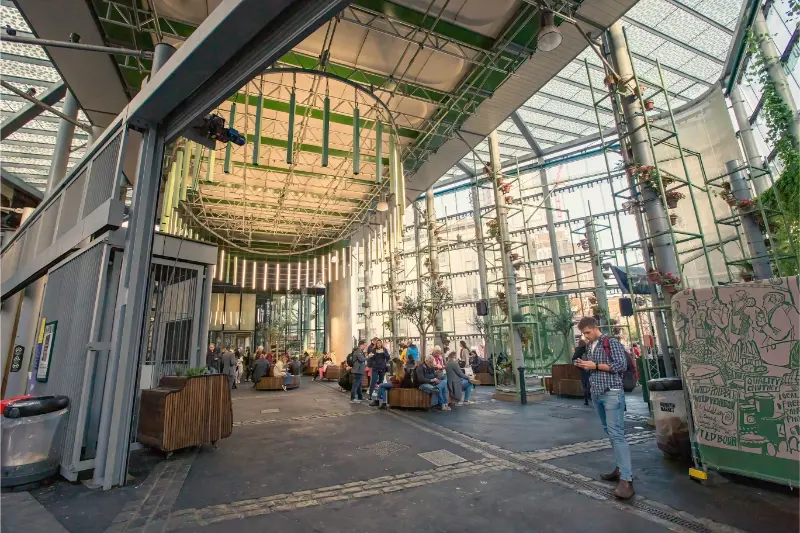
Borough Market is often described as a street-food stop, which undersells it. It is a working food market with a long history, specialist produce traders, restaurants, bakeries and takeaway counters compressed into a complex of railway arches and covered spaces beside London Bridge. That variety is exactly why first-time visitors can make poor decisions: they arrive hungry at the busiest moment, follow the longest queue, eat standing in a bottleneck and leave thinking the market is only a tourist feeding station.
A better visit begins with timing and a short walk before you buy anything. This guide is about using Borough Market as part of London rather than as a checklist lunch. For the wider food picture, read our what to eat in London guide and London markets comparison.
| Best for | Food lovers, market culture, quick tastings and London Bridge itineraries |
|---|---|
| Nearest station | London Bridge |
| Best strategy | Arrive before the main lunch rush, walk one full loop, then decide what to eat |
| Do not miss | Produce and specialist traders, not only hot-food queues |
Why Borough Market matters
The market’s history stretches back many centuries. Its current story includes periods as a wholesale fruit and vegetable market and a late-twentieth-century reinvention around high-quality retail food. The official Borough Market history traces documented activity through medieval London and the market’s relocation to its present area in the eighteenth century. That continuity helps explain why the site feels layered rather than purpose-built for visitors.
Read a little of the official Borough Market history before your trip and the architecture around you becomes more interesting: railway infrastructure, old market fabric and modern food culture occupy the same space.
When to go if you dislike crowds
Lunch is naturally the busiest period, particularly Friday and Saturday. Arriving near opening gives you room to see counters, talk to traders and decide what you actually want. Late afternoon can also be calmer, but some popular items may sell out and not every trader keeps identical hours.
Under Borough Market’s current regular 2026 schedule, Monday is closed; Tuesday to Friday are generally 10:00–17:00, Saturday 09:00–17:00 and Sunday 10:00–16:00. Bank holidays and the festive period can change that pattern, so verify the official Borough Market visit page before making it the fixed lunch anchor of your day.
Walk the market once before joining a queue
This single rule improves the experience more than any list of “must-eat” dishes. Walk through the main areas, look at produce, note what is being cooked and pay attention to serving speed. A long queue can mean excellent food, but it can also mean social-media fame, slow assembly or a very photogenic product. Your appetite deserves a better method than queue length.
Decide whether you want a meal or a tasting session. For a meal, choose one substantial dish and somewhere sensible to eat it. For tastings, split two or three smaller items with a travel companion and leave room for cheese, baked goods or dessert.
What should you eat?
There is no single Borough Market dish. That is the point. You can find British cheese, bread, charcuterie, seafood, meat, pastries, fresh produce and food from many international traditions. If this is your only London food stop, include at least one British product rather than eating something you could easily find at home.
Cheese is particularly useful because it connects the market with British regional food. Baked goods travel well if you are continuing along the river. Hot dishes are best judged by what smells good, what is being cooked freshly and whether you have somewhere comfortable to eat.
Where do you eat without blocking everyone?
The worst market habit is stopping immediately after collecting food and creating a human dam beside a popular stall. Move away from the serving area. Borough Market has nearby public spaces, the river is close, and the streets around Southwark Cathedral offer a change of pace. Follow current signage about where food may be consumed and keep access routes clear.
If you want a proper seated meal, use one of the surrounding restaurants rather than expecting a street-food counter to behave like a dining room. This is especially sensible in winter or with young children.
The overlooked side: shopping rather than snacking
Visitors staying in an apartment or planning a picnic should look beyond ready-to-eat food. Market traders sell ingredients that can turn a simple hotel or rental meal into something memorable. Even if you cannot cook, a small combination of bread, cheese, fruit and something sweet can become a Thames-side picnic.
Remember that fresh food does not always travel well on a full sightseeing day. Buy perishable items near the end of your visit or when you can return to accommodation soon.
Borough Market + South Bank is one of London’s easiest combinations
The market sits naturally toward the eastern end of a classic South Bank walk. You can start at Westminster, pass the London Eye and cultural venues, continue by Tate Modern and Shakespeare’s Globe, then reach Borough Market for lunch. After eating, cross London Bridge or continue toward Tower Bridge.
Our South Bank London guide gives the full sequence, while Tower Bridge guide helps if you want to continue inside the bridge rather than simply photograph it.
Is a food tour worth it?
A guided food tour can be worthwhile if you want context, preselected tastings and the confidence to try foods you might otherwise overlook. It is less useful if you simply want an inexpensive lunch. Check how much food is included, group size, dietary accommodation and whether the route extends beyond the market into Southwark.
Affiliate link. Dreaming London may earn a commission from qualifying bookings at no extra cost to you.
Borough Market with children
Families should visit before peak lunch whenever possible. Let children choose one item each rather than dragging them through repeated adult tastings. The market is stimulating and crowded; a simple task — find a bread, a cheese and a dessert to share — gives the visit structure. Afterwards, the riverfront provides space and movement.
Dietary requirements
Choice is broad, but never assume an item is suitable because its appearance suggests vegetarian, vegan, halal, gluten-free or allergen-free preparation. Ask the trader directly about ingredients and cross-contamination. Busy market kitchens can handle many products in small spaces, and dietary safety deserves a real conversation rather than guesswork.
Common mistakes
- Arriving at the exact middle of the Saturday lunch rush and expecting a relaxed browse.
- Eating at the first viral stall you recognise without seeing the rest of the market.
- Ignoring produce and specialist shops because hot food photographs better.
- Buying too much food at once and carrying it for hours.
- Scheduling a formal restaurant booking immediately after a market tasting session.
How to create a tasting plan without overspending
Set a rough food budget before entering and decide whether you are buying a meal, ingredients or small tastings. Market spending grows quickly because individual purchases feel inexpensive in isolation. Sharing works well: one savoury item, one specialist product and one sweet stop can provide more range than two large lunches.
Bring a refillable bottle and avoid buying drinks repeatedly unless they are part of what you specifically want to taste. If you are continuing on foot, consider packaging and mess. The best market choice is not always the biggest one; it is the food you can actually enjoy without balancing several containers beside a crowded passage.
Look beyond social-media popularity
Some of Borough Market’s value is in traders that are not visually dramatic: cheese counters, produce, bread, spices and ingredients. Ask questions when staff have time. A short conversation about origin, season or preparation can be more memorable than queueing for the most photographed sandwich. This is also where the market feels most connected to food culture rather than pure tourism.
What to do after lunch
Borough Market is easier to enjoy when lunch is not the end of the plan. Walk to Southwark Cathedral, continue along the river toward Shakespeare’s Globe and Tate Modern, or head east toward HMS Belfast and Tower Bridge. Ten minutes of walking also solves the common problem of feeling too full to enjoy another attraction immediately.

If you bought food to take away, check whether it needs refrigeration before committing to several more hours outside. A market souvenir should not become something you carry around central London until it is no longer safe or enjoyable to eat.
Frequently asked questions
Is Borough Market free to enter?
Yes, access to the market is free. You pay only for what you buy.
Is Borough Market open every day?
Not under the current regular schedule. Opening days and hours can change, particularly around holidays, so check the official site before travelling.
How much time do you need?
Forty-five minutes is enough for a look and one bite; 90 minutes to two hours is more realistic if food is a major interest.
Is it only for tourists?
No. Tourism is highly visible, but the market also functions around serious food retail, producers, restaurants and the local community.
The best way to leave Borough Market
Do not immediately dive back underground. Walk. Cross London Bridge for City views, follow the river east toward Tower Bridge, or retrace a short section west toward Tate Modern. Food is the reason most people arrive, but geography is what makes Borough Market such a strong London stop. It sits exactly where market history, rail infrastructure, Southwark streets and the Thames meet.
Compare Borough with other food markets
Use our best London food markets guide to compare Borough with Camden, Greenwich, Maltby Street, Broadway Market, Brixton and Seven Dials.
Walk beyond Borough Market into Bermondsey
For Maltby Street, Bermondsey Street and contemporary art, continue with our Bermondsey guide.