
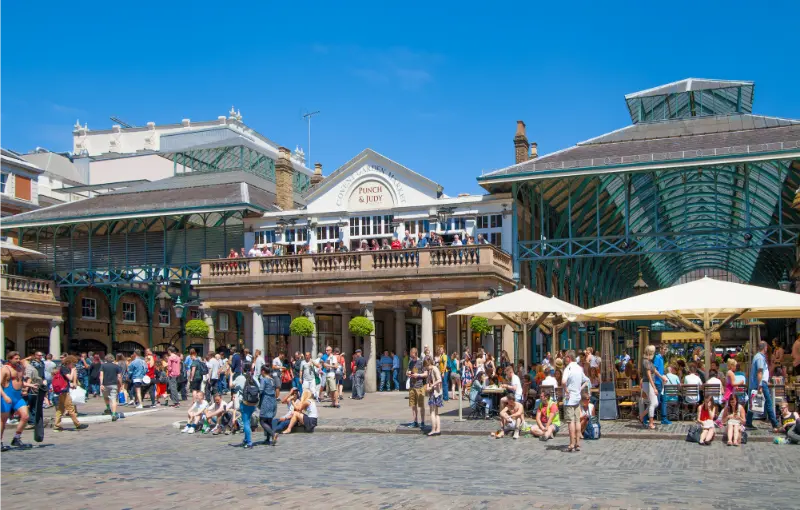
Covent Garden is one of the easiest places in London to enjoy without a plan. Step outside and you are surrounded by theatres, restaurants, pedestrian streets, the Piazza, the Royal Opera House and short walks toward Trafalgar Square, Soho and the Thames. That convenience is exactly why hotels here are expensive and why a careless room choice can mean late-night noise, tiny floor space and a premium price for a postcode you do not fully use.
This guide focuses on accommodation decisions rather than sightseeing. For the neighbourhood itself, read our Covent Garden walking guide. If you are still comparing districts, start with the best areas to stay in London guide and come back here once the West End is on your shortlist.
Covent Garden at a glance
Real hotels to put on your shortlist in Covent Garden: The Resident Covent Garden (well-located boutique option for theatres and first visits); NoMad London (luxury design-led choice in the heart of Covent Garden); and Henrietta Experimental (small boutique stay for atmosphere and dining). Hotel prices and room types change by date, so compare the exact room, cancellation terms and recent reviews before booking.
| Micro-area | Best for | What feels different | Main compromise |
|---|---|---|---|
| Piazza / Long Acre | First visits, shopping, short city breaks | Maximum centrality and constant activity | Crowds and noise |
| Seven Dials | Independent shops, food, theatre | Smaller streets and a more intimate feel | Busy evenings |
| Strand / Aldwych | Theatre, river, business trips | Larger hotels and easy east-west walking | Traffic on main roads |
| Charing Cross edge | Westminster plus West End | Excellent walking connections and rail access | Tourist traffic and higher rates |
| Holborn edge | Value-conscious central stays | Still walkable to Covent Garden with more room choice | Less atmosphere directly outside the door |
Who should stay in Covent Garden?
Covent Garden is strongest for travellers who want to do a lot on foot. It suits a first London visit, a theatre weekend, couples who like evening dining without a return Tube journey, and short stays where every hour matters. If your plan includes the National Gallery, Soho, Chinatown, Westminster, the British Museum and several West End shows, the location can remove a surprising amount of transport from the trip.
It is less convincing for travellers who need a large room at a low price, drivers, light sleepers who insist on opening windows onto busy streets, or visitors whose itinerary is concentrated in East London or outer neighbourhoods. Families can still do very well here, but room size, breakfast logistics and late-night noise deserve more attention than they might in Bloomsbury or South Kensington.
The Piazza and Long Acre: pay for being in the middle of everything
Staying close to the Piazza means you can walk out early, see the market buildings before the day crowds thicken and return easily between activities. It is excellent when your trip is built around theatre and dining. The disadvantage is obvious: this is not a sleepy residential pocket. Street performers, restaurants, deliveries, taxis and people leaving shows can create noise well into the evening.
The practical question is not whether the hotel is ‘in Covent Garden’ but where the bedroom faces. A rear room or upper-floor room may be significantly calmer than a front-facing room on a restaurant street. Read recent reviews for noise language such as ‘street-facing’, ‘courtyard’, ‘club nearby’ and ‘windows do not open’. Those details are more useful than generic comments about location.
Seven Dials: my favourite compromise for atmosphere
Seven Dials sits between Covent Garden, Soho and Bloomsbury and often feels more human in scale than the busiest part of the Piazza. The small streets are packed with cafes, shops and restaurants, and you can reach Leicester Square, Tottenham Court Road and the theatre district quickly. For visitors who want to wander after dinner rather than head straight back to a large station, it is an appealing base.

It is still central nightlife territory, so do not interpret ‘smaller streets’ as silence. If your stay includes Friday or Saturday night, check what operates at ground level beneath or beside the property. A beautiful boutique room over a bar can be a poor match for an early-start sightseeing schedule.
Strand and Aldwych: useful for theatre and the river
The Strand and Aldwych edge works well for travellers who want a substantial hotel, convenient taxi access or a slightly more formal streetscape. From here you can walk south to the Thames, east toward the City and west into Trafalgar Square. Somerset House and several major theatres are close, and Temple or Holborn may be more useful than Covent Garden station depending on the exact address.
Main-road rooms can experience traffic noise, so ask about orientation. On the positive side, larger buildings in this corridor may have more reliable lifts, bigger common areas and a wider range of room categories than tiny converted properties on side streets. That can matter for families or anyone travelling with several suitcases.
Do not obsess over Covent Garden station
Covent Garden station is convenient but it is not the only useful station for the neighbourhood. Leicester Square, Charing Cross, Holborn, Tottenham Court Road and Temple can all be sensible depending on the hotel. This matters because station choice affects airport routes and day-to-day transfers. A hotel ten minutes from the Piazza but close to two useful lines can be more practical than one beside the market with only one preferred route.
Use the official TfL Journey Planner with the hotel postcode before booking. Test three real journeys: your arrival airport, one attraction outside the West End, and your latest planned evening. The goal is not to find the shortest theoretical journey but to understand how many changes, stairs and long station corridors are involved.
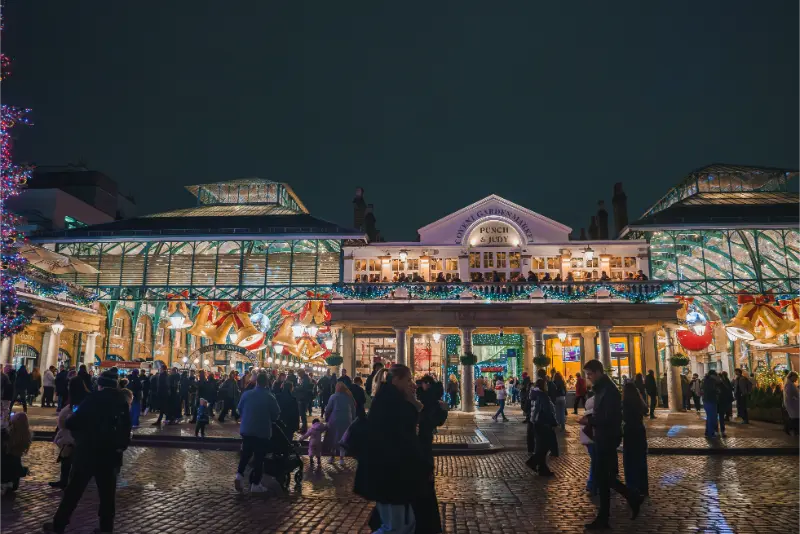
Walking advantages that actually save time
- Soho and Chinatown: often easier on foot than by Tube; useful for restaurants and nightlife.
- Trafalgar Square and the National Gallery: a straightforward walk for most visitors.
- British Museum: walkable via Seven Dials and Bloomsbury; combine it with a neighbourhood day.
- South Bank: cross via Waterloo Bridge for river walks, the Southbank Centre and views.
- Westminster: reasonable on foot through Trafalgar Square and Whitehall when weather is good.
The biggest mistake is trying to convert every walkable route into a walking obligation. After a matinee, museum and dinner, the bus may be the better choice. Centrality gives you options; it does not require you to prove how far you can walk.
Theatre trips: this is where Covent Garden earns its price
If you are coming specifically for West End shows, Covent Garden is hard to beat. You can dine before the performance without calculating a cross-city transfer, and after the curtain you can walk back while Tube stations are crowded. Our West End theatre guide explains ticket and seating strategy; combine it with a hotel map so your evening is built around a cluster rather than scattered reservations.
Check the theatre location before choosing the hotel. ‘West End’ covers a wide area. A show near Victoria, Shaftesbury Avenue and the Strand do not create identical walks. If you have tickets for several performances, a Seven Dials or Leicester Square edge often gives the broadest balance.
Families in Covent Garden
Families benefit from short walks to attractions, restaurants and transport, but the accommodation itself needs scrutiny. Triple and quad rooms are not standard in every central London hotel. A room advertised for three may use a sofa bed that leaves very little floor space. Confirm bed configuration and whether the lift reaches your floor before booking.
For younger children, proximity to open space is the main weakness. Covent Garden has squares and pedestrian streets but not a large park at the door. If daily park time matters, South Kensington, Bloomsbury or Victoria/Pimlico may be easier. Our London with kids accommodation guide compares those alternatives.

Late-night noise: how to judge a street
Do not rely on a district-wide reputation. One Covent Garden street can be quiet after theatres close while the next has bars, deliveries or taxi queues. Open a map, identify pubs and late restaurants on the same block, and read reviews from guests who stayed on weekends. If the hotel has a bar or restaurant on the ground floor, ask whether guest rooms directly above it are part of the room category you are booking.
If you want the neighbourhood but not the noise, look toward the Holborn or Bloomsbury edges, or choose a property on a side street and request a rear-facing room. You give up a few minutes of postcard centrality and often gain better sleep.
Airport arrival and departure
No London airport has a single direct ‘Covent Garden’ answer. Heathrow can work via the Piccadilly line or Elizabeth line plus a short connection or walk, depending on your luggage and exact hotel. Gatwick often makes Charing Cross-adjacent or Thameslink connections more interesting than the neighbourhood name suggests. Stansted and Luton usually involve a mainline or express service followed by a central connection.
If you arrive after a long flight, test the route with your actual arrival time and luggage. A route with one fewer change can be worth a few extra minutes. Our London airports to city centre guide is a better starting point than choosing a hotel simply because a booking site labels it ‘central’.
How to choose between two hotels
- Compare the exact room size and bed configuration, not only star category.
- Check whether the room faces a pedestrian nightlife street, a main road or an internal courtyard.
- Measure walking time to two stations, not just Covent Garden station.
- Read the most recent reviews for lifts, air conditioning, hot-water pressure and noise.
- If theatre is your priority, map your actual venues before paying more for the wrong side of the district.
- Check luggage storage and cancellation policy; both can be worth more than a decorative room upgrade.
Booking and official information
For current neighbourhood listings, the official visitor site has a dedicated Covent Garden and Strand accommodation page. For live availability and date-specific rates, compare London accommodation on Booking.com using map view rather than sorting only by price.

Affiliate link. Dreaming London may earn a commission from qualifying bookings at no extra cost to you.
Common mistakes
- Paying extra to be beside the Piazza when most evenings are elsewhere.
- Assuming pedestrian streets are automatically quiet at night.
- Choosing by star rating without checking actual room size.
- Ignoring nearby stations such as Leicester Square, Holborn or Charing Cross.
- Booking a family room without confirming the real bed layout.
- Planning every day on foot just because the hotel is central.
Frequently asked questions
Is Covent Garden a good place to stay for a first visit?
Yes, especially for a short trip focused on classic central London, theatre, dining and walking. It reduces transport needs and keeps evenings simple. The main costs are higher room rates, compact rooms and possible street noise.
Is Covent Garden too touristy to stay in?
It is busy and visitor-oriented, particularly around the Piazza, but the district changes street by street. Seven Dials and the Holborn edge can feel less intense while keeping the same central convenience.
Covent Garden or Soho?
Choose Covent Garden for theatre, polished pedestrian streets and a slightly easier first-time sightseeing base. Choose Soho for nightlife, restaurants and a stronger late-evening atmosphere. The two areas are close enough that exact hotel street and price may matter more than the label.
Can I reach the South Bank easily?
Yes. Waterloo Bridge is one of the most useful walking links from this area, and the route gives excellent river views. Our South Bank guide helps turn that crossing into a full sightseeing route.
Bottom line
Covent Garden works best when you intend to use its centrality morning and night. Stay near the Piazza for maximum convenience, Seven Dials for atmosphere, Strand/Aldwych for larger hotels and east-west access, or the Holborn edge for a better chance of value. The right room here is not simply the closest to the market; it is the one that balances walking convenience with sleep, space and the routes you will actually use.
Affiliate widget. DreamingLondon may earn a commission from qualifying bookings at no extra cost to you.