
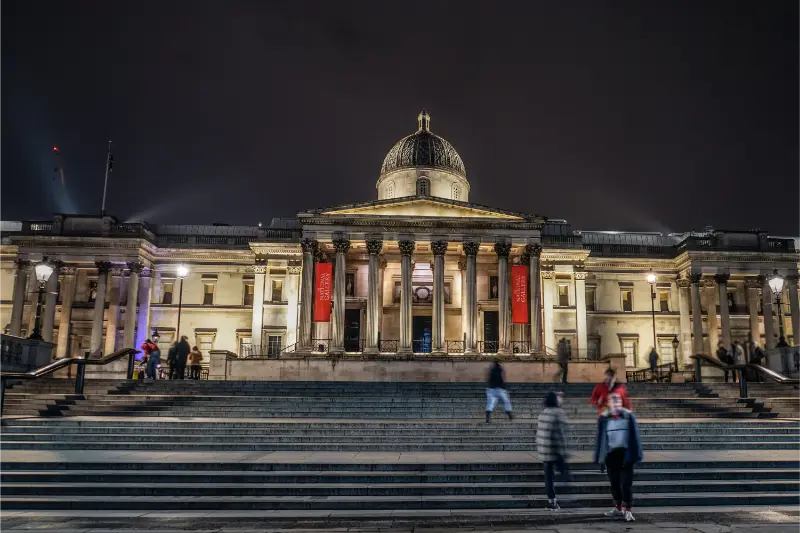
The National Gallery is one of those London museums that can be either magnificent or exhausting. The collection is free to enter, the location on Trafalgar Square could hardly be more central, and more than a thousand paintings may be on display at any one time. The problem is obvious: if you arrive without a plan and try to “do the whole museum”, the rooms quickly become a blur. A better first visit is selective. Give yourself two or three hours, decide which periods or artists matter most to you, and leave while you are still looking carefully rather than merely moving from label to label.
This guide is built for that kind of visit. It explains how to use the National Gallery efficiently, what to prioritise, where it fits into a central London day and how to avoid duplicating what you may already see at the British Museum, the V&A or Tate Modern. General admission is free; the Gallery recommends booking a free timed ticket for faster entry, while walk-up admission is also possible. Always check the official National Gallery visitor page before travelling because room closures and temporary exhibitions change.
| Best for | Painting, art history, first-time London visitors |
|---|---|
| General admission | Free; some temporary exhibitions are ticketed |
| Good first-visit length | 2–3 hours |
| Main entrance | Sainsbury Wing, Trafalgar Square |
| Best pairing | Westminster, Covent Garden, Soho or a West End evening |
Why the National Gallery deserves a dedicated visit
The National Gallery is not a museum of every type of object. Its focus is Western European painting from the late medieval period to the early twentieth century, which makes it unusually coherent. You can move from religious panels and Renaissance experiments in perspective to Dutch interiors, grand portraits, landscapes, Romanticism and the colour of the nineteenth century without changing museum. That continuity is one reason a two-hour visit can still feel substantial.
It is also one of London’s best-value major attractions. You do not need to justify an expensive ticket by staying for six hours. You can visit for ninety minutes, return another day, or use a Friday evening to see a smaller selection. That flexibility makes it ideal for travellers building a realistic itinerary rather than trying to maximise the number of objects seen per pound.
A sensible first route: start with a question, not a room number
Room numbering and displays can change, especially when paintings travel or galleries are reconfigured. Instead of memorising a fixed sequence, choose a chronological or thematic question. You might ask: how did European painting move from gold-background devotional images toward convincing space and human presence? How did portraiture become more psychologically direct? How did landscape change from background scenery into the main subject? A question gives the rooms a narrative even when individual works move.
For a first visit, I would divide the museum into four broad stages: early Renaissance and Renaissance painting; seventeenth-century Dutch, Flemish and Spanish work; eighteenth- and early nineteenth-century British and European painting; then nineteenth-century French and Post-Impressionist work. Spend longer in the stage that interests you most and skim the rest. The goal is recognition and comparison, not completion.
Six paintings worth slowing down for
Famous works are not automatically the “best”, but a handful make useful anchors because they open a door into larger parts of the collection. Jan van Eyck’s Arnolfini Portrait rewards close looking at reflections, surfaces and tiny details. Leonardo da Vinci’s Virgin of the Rocks shows how composition, gesture and atmosphere can unify a complex religious scene. Diego Velázquez’s Rokeby Venus is useful for thinking about gaze and representation. J.M.W. Turner’s The Fighting Temeraire turns a historical subject into an image of technological and national change. Vincent van Gogh’s Sunflowers demonstrates how familiar reproductions flatten texture and colour. A Monet landscape makes a strong final comparison with the tighter techniques encountered earlier.
Do not treat that as a compulsory checklist. Paintings may be temporarily off display, on loan or moved. Use the Gallery’s collection search on the day of your visit and choose alternatives if necessary. The deeper lesson is to stop in front of a few works long enough to notice decisions about light, scale, viewpoint, brushwork and storytelling.
How long do you really need?
For most first-time visitors, two to three hours is the sweet spot. Ninety minutes works if you choose ten to fifteen works in advance. Four hours is reasonable for art enthusiasts, but only if you include a proper break. Beyond that, visual fatigue usually becomes the limiting factor. If your day also includes Westminster or Covent Garden, a disciplined museum visit is far better than exhausting yourself before the rest of the day.
A simple technique is to set a “last room” before you start. Once you reach it, decide whether you still have concentration for more. This sounds trivial, but it prevents the common pattern of spending most of your energy on the first galleries and then rushing past paintings you actually care about.
When to go for a calmer experience
The National Gallery is central, free and famous, so there is no secret hour when it is empty. Under the current visitor schedule it is normally open daily from 10:00 to 18:00 and until 21:00 on Fridays; it closes on 24–26 December and 1 January. General admission is free. You can book a free ticket for faster entry and visitor updates, while walk-up entry is also available. Opening time is useful if you want a focused visit before Trafalgar Square becomes busier; Friday evening is especially useful if you prefer museums later in the day. Check the National Gallery’s official visit page before travelling because exceptional hours can still apply.
If one room is crowded because a tour group has arrived, move on and come back. The building is compact enough that you rarely need to stand in a queue of people simply because a famous painting is temporarily surrounded. This flexibility is one of the advantages of a free permanent collection.
National Gallery with children
Families usually do better with a mission than with an art-history lecture. Ask children to find animals, mirrors, storms, unusual clothes or the smallest figure they can spot in a large painting. Choose six works rather than sixty. The museum becomes a place for observation instead of a test of patience. If you are planning several family attractions, compare the museum day with our broader London with kids guide.

Because admission to the permanent collection is free, there is no pressure to stay when attention disappears. You can leave, cross Trafalgar Square, take a break and continue your day. That makes the National Gallery easier with children than many expensive timed attractions.
What to combine with the National Gallery
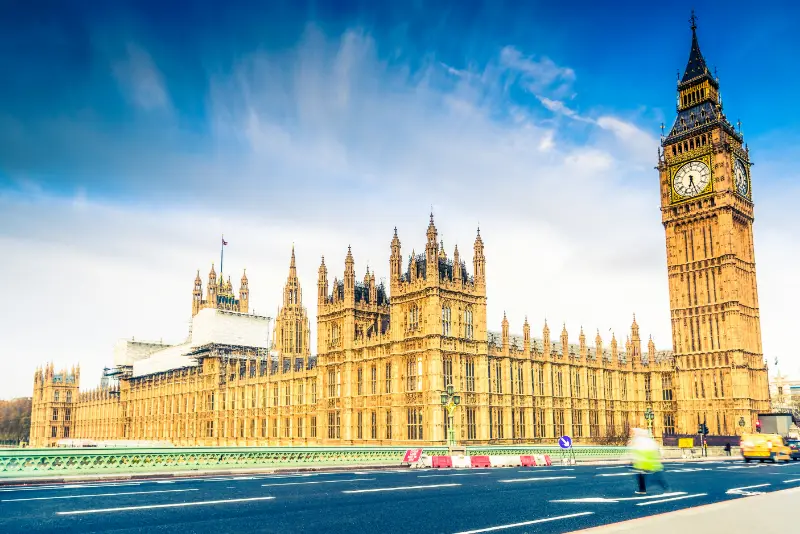
The location is almost as valuable as the collection. From Trafalgar Square you can walk to Whitehall and Parliament Square, into St James’s, through Leicester Square to Chinatown and Soho, or east toward Covent Garden. A very efficient day is Westminster in the morning, lunch around Covent Garden, two hours in the Gallery and a West End show in the evening.
If you want a second, shorter art stop, the National Portrait Gallery is immediately beside Trafalgar Square and creates a much more manageable pairing than crossing London for another huge collection. For a different day focused on British art from Tudor portraiture to Turner and the twentieth century, use our Tate Britain guide. Otherwise, pair the Gallery with one of our central London walking routes. Two heavyweight museums in one day often sound efficient on paper but produce diminishing returns.
Should you book a guided tour?
A good guided tour can be worthwhile if you want a narrative and do not already know which parts of the collection interest you. It is especially useful for a short first visit because a guide can connect works across periods instead of giving isolated facts. If you already enjoy choosing paintings independently, the free collection plus the Gallery’s own interpretation may be enough.
Affiliate link. Dreaming London may earn a commission from qualifying bookings at no extra cost to you.
Practical details that save time
Use the Sainsbury Wing entrance, which the Gallery identifies as its main entrance and which provides step-free access. Book the free general-admission slot if you want the smoothest arrival, but do not confuse a free admission reservation with a ticket for a temporary exhibition. Security and bag policies can change, so travel light if possible. Save the museum map to your phone before arrival, but be willing to ignore it when a quieter room catches your attention.
Food inside a museum is convenient, but central London gives you endless alternatives within a short walk. Unless you specifically want to eat in the Gallery, I prefer using museum time for art and taking the break outside in Covent Garden, Soho or St James’s.
Common mistakes
- Trying to see every room: the result is usually fatigue, not a deeper visit.
- Only photographing famous paintings: spend time looking before reaching for the phone.
- Scheduling another huge museum immediately after: alternate art with walking, food or a neighbourhood.
- Ignoring Friday evening: later opening can make an excellent itinerary tool.
- Assuming every famous work is always on display: check the collection page before travelling.
Frequently asked questions
Is the National Gallery free?
General admission to the permanent collection is free. Some temporary exhibitions require a paid ticket. A free timed general-admission reservation is recommended for faster entry, although walk-up entry is also available.
Is two hours enough?
Yes. Two focused hours can be better than four unfocused ones. Choose several periods or a short list of paintings and leave time for nearby London rather than treating the Gallery as an endurance event.
Is it the same as the National Portrait Gallery?
No. They are separate institutions, although they are very close to each other. The National Gallery focuses on paintings in the Western European tradition; the National Portrait Gallery focuses on portraits connected with British history and culture.
What is the best nearby attraction?
For first-time visitors, Westminster or Covent Garden are the easiest combinations because both are walkable and create a varied day. If you are seeing a show, the West End is even more convenient.
My preferred way to visit
I would arrive with no more than ten “must-see” paintings, start early or use a Friday evening, spend the first hour moving chronologically, then use the remaining time to follow whatever catches my attention. That balance between preparation and freedom is what makes the National Gallery work. The collection is too rich to finish, and that is a strength rather than a problem. A successful first visit should leave you wanting to return.