
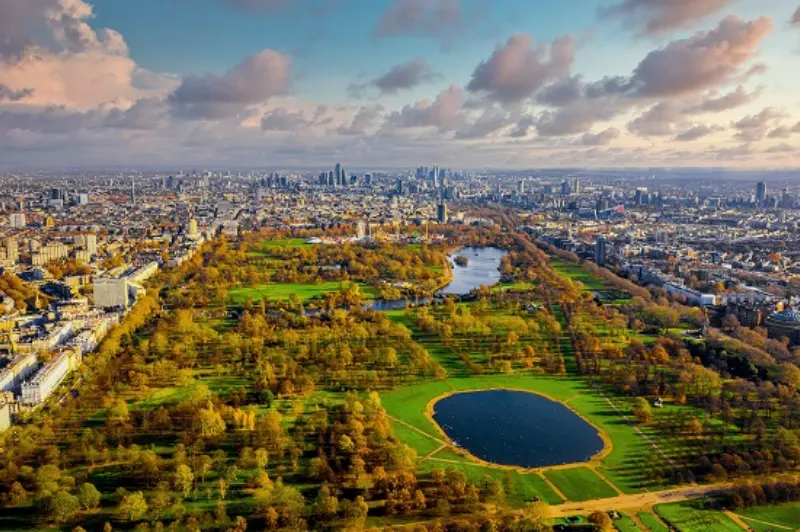
Hyde Park and Kensington Gardens look like one enormous green space on many maps, which leads visitors to treat them as a shortcut between attractions. They deserve better. The two adjoining parks contain royal history, memorials, long walking avenues, the Serpentine, gardens, playgrounds and some of the easiest breathing room in central London. They are also a practical bridge between Westminster, Knightsbridge, South Kensington and Notting Hill.
This guide focuses on a west-to-east or east-to-west walk that can be shortened at several points. It links directly with our Kensington guide, Notting Hill guide and best London walks.
| Best for | Walking, families, monuments, gardens and itinerary breathing room |
|---|---|
| Cost | Free general access |
| Useful time | 2–4 hours depending on stops |
| Good connection | Kensington/Notting Hill ↔ Knightsbridge/Mayfair |
| Main planning factor | Seasonal gate times in Kensington Gardens |
Understand the two-park geography
Kensington Gardens lies to the west; Hyde Park continues east. The boundary is easy to cross without noticing if you are following the water or broad paths. For itinerary purposes, think of the combined landscape as a long green corridor. Enter from the side closest to your previous attraction and keep moving generally toward your next neighbourhood.
Kensington Gardens highlights
Kensington Palace, the Albert Memorial, formal gardens, broad tree-lined paths and family areas give the western side a more royal and landscaped character. If the palace is a priority, treat it as a separate ticketed attraction rather than assuming it can be absorbed into a park walk in twenty minutes.
The Serpentine as an orientation line
The water gives the combined parks a useful visual anchor. Walking near it helps you avoid constant map checking and creates a natural central route. You do not need to hug the shoreline the entire way; use it to understand where you are, then detour to monuments or quieter paths.
Hyde Park changes toward the east
As you approach Hyde Park Corner and Park Lane, the city becomes more present again. Memorials and major roads frame the edge, while the open lawns still create distance from traffic. This eastern side works well before continuing into Mayfair or toward Buckingham Palace and Westminster.
A 2.5-hour walking route
- Start near Kensington Palace or the west side of Kensington Gardens.
- Walk through the gardens toward the Albert Memorial area.
- Continue toward the Serpentine and choose one lakeside section.
- Cross into Hyde Park and follow a broad eastward route.
- Finish near Hyde Park Corner, Marble Arch or Park Lane depending on your next stop.
With children
The parks are valuable for families because they provide unstructured time between attractions. Do not turn the walk into another checklist. Choose one playground or open area, allow children to move freely and keep the route shorter than you would for adults. This is particularly helpful after a South Kensington museum morning.
Kensington Palace: separate attraction, separate decision
Kensington Palace can be a meaningful royal-history visit, but entry is ticketed and the interior requires time. If you want the palace, give it a proper slot and shorten the park walk. If you only want gardens and exterior context, enjoy the park without feeling obliged to buy another ticket.
Seasonal opening and events
Royal Parks opening times and event arrangements vary. Kensington Gardens generally closes at dusk while Hyde Park has different access patterns, and major events can temporarily affect routes. Check Hyde Park and Kensington Gardens information before relying on a late-evening crossing.
Winter and Christmas period
Hyde Park can host major seasonal events that change the atmosphere, crowd levels and movement around parts of the park. Even if you are not attending an event, surrounding transport and paths may be busier. Build extra time into the route and check closures rather than assuming a normal summer map applies.
Where to eat
There are cafés and kiosks in and around the parks, but you do not need to plan the walk around one specific venue. On good-weather days, a simple picnic can be one of the most enjoyable uses of the space. If you want a proper meal, the surrounding neighbourhoods offer far more choice than the park itself.
Accessibility and route length
Main paths are generally easier than many central-London streets, but the combined parks are large. Travellers with limited walking tolerance should choose one half rather than trying to cross the full landscape. Exit points toward public transport are frequent enough to make a shorter route practical.
Frequently asked questions
Are Hyde Park and Kensington Gardens the same park?
They are adjoining Royal Parks with different identities and access arrangements, although visitors can walk between them easily.
How long does it take to walk across?
A direct crossing can be relatively quick, but a meaningful sightseeing walk with stops is better planned as two to four hours.
Is the park safe after dark?
Use normal city awareness and respect gate closures. For a sightseeing itinerary, daylight and early evening are usually more enjoyable because views and park features are easier to appreciate.
Can you combine the parks with museums?
Yes. A focused South Kensington museum visit followed by Kensington Gardens is one of the best balanced combinations in the area.
The hidden value is pacing
These parks are not only attractions. They are infrastructure for a better London trip. A long green walk can replace a Tube journey, connect several neighbourhoods and give your brain a break from crowds and ticketed sights. Used that way, Hyde Park and Kensington Gardens become part of the rhythm of London rather than another item to complete.
Think of Hyde Park and Kensington Gardens as one continuous green corridor
Visitors often treat the two parks as separate attractions because the names change, but on foot they function as a long west-east green route. That makes them useful for connecting Kensington and South Kensington with Mayfair, Marble Arch and the royal quarter without spending the whole journey beside traffic.
Choose a direction based on the rest of your day. If you are visiting museums in South Kensington, walking east after the museum can lead toward central London. If you start near Westminster or Mayfair, heading west creates a natural transition toward Kensington.
The Serpentine is a navigation tool
The Serpentine and Long Water divide and orient the landscape, making it easier to understand where you are than a dense street map does. Use the water as a spine, then choose detours toward memorials, gardens or museums depending on your interests.
This is particularly useful with children: instead of announcing another “attraction,” let the route be about ducks, open lawns, boats or a snack stop, then rejoin the sightseeing plan afterward.
Diana Memorial Playground and family pacing
Families with younger children can use Kensington Gardens as a genuine play break rather than a scenic corridor. The Diana Memorial Playground is a destination in its own right, but access and busy-period arrangements can change, so check current information before promising children a specific entry time.
After a morning museum visit, an outdoor play period can be much more valuable than a second museum. Our London with kids guide explains why this alternating rhythm works so well.
Bad weather changes the route, not the whole day
In steady rain, do not force the full park crossing. Use shorter segments between indoor anchors such as Kensington Palace, the museums or nearby cafes. When the rain passes, re-enter the park at the closest gate. London’s large parks are useful precisely because you can sample them in sections rather than complete a prescribed circuit.
For a weather-first plan, see our rainy-day London itinerary.
Memorials and landmarks: choose a few, do not zig-zag across the park
The parks contain fountains, memorials, sculptures and historic features, but chasing every named point can turn an easy green walk into a confusing zig-zag. Decide whether your route is about the Serpentine, Kensington Palace, gardens, family play or simply getting from west London toward the centre. Add landmarks that naturally sit along that line.
This principle matters with limited mobility too. A direct, enjoyable route with frequent benches is more valuable than a theoretical “complete” park circuit that creates unnecessary distance.
Morning and evening feel very different
Early mornings are better for quiet paths, joggers and soft light; afternoons bring picnics and heavier visitor traffic; summer evenings can be lively long after museum closing time. If the park is primarily a walking route, choose the time that fits your energy. If photography is the goal, low light usually adds more depth than a bright midday crossing.
Seasonal daylight changes dramatically in London, so a winter park plan needs a much earlier start than a summer one.
Picnic or cafe?
Both parks work well for a simple picnic, but carrying food all morning can be annoying on a museum day. Buy something shortly before entering the park or use a cafe when the weather is uncertain. The best choice is the one that preserves the walk rather than forcing a detour across the park because one specific snack was on a list.