
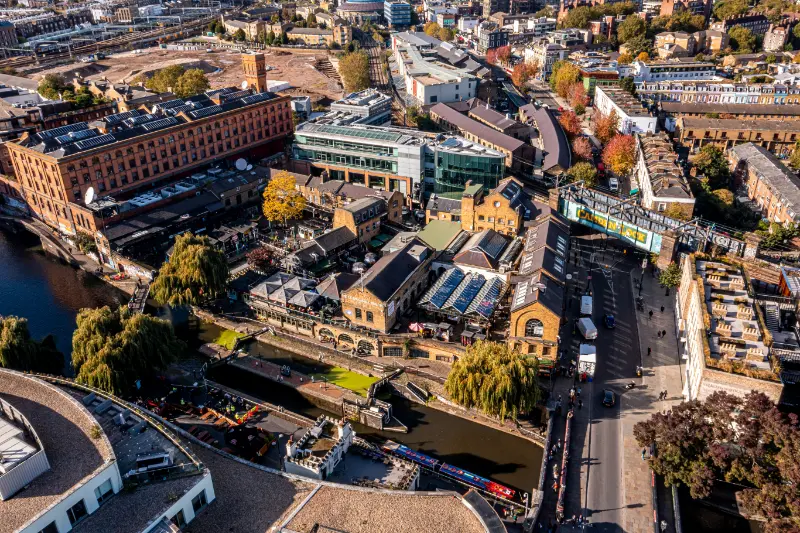
Camden is one of London’s most recognisable neighbourhoods, but a lot of visitors see only its busiest stretch: exit Camden Town station, walk through the crowds, buy food, photograph a shopfront and leave. That is the least interesting version of the area. A better visit connects Camden Market with the Regent’s Canal, the Stables, music history, quieter streets and — if you have time — a walk toward Primrose Hill or Regent’s Park.
| Best for | Markets, street food, music history, canal walks, alternative shopping |
|---|---|
| Minimum time | 2–3 hours; half a day with canal or Primrose Hill |
| Nearest stations | Camden Town, Chalk Farm, Camden Road |
| Best tip | Enter from one station and leave from another instead of backtracking |
Camden Market is not one single hall
The term Camden Market covers a cluster of market spaces and trading areas around Camden Lock, the Stables and Hawley Wharf. The official market site lists different opening patterns for its components and notes that individual traders can keep different hours. That matters because a visitor expecting one traditional street market can be confused by the mixture of food halls, stalls, permanent shops and restored industrial structures.
The most useful approach is to walk through without trying to inspect every stall. Decide whether you are primarily interested in food, vintage clothing, design, souvenirs or simply the atmosphere. Otherwise the size and repetition can become tiring before you reach the canal.
Arrive early if crowds change your experience
Camden is lively because it is popular, not despite it. Weekends and afternoons can be intensely busy around the station and market entrances. If you want clearer photography and easier browsing, arrive earlier and let the area fill around you. If you want maximum atmosphere, come later and accept slower movement.
Camden Town station is convenient, but Chalk Farm can be a smart alternative if you plan to explore the Stables first or continue toward Primrose Hill. Camden Road Overground is another useful option depending on where you are coming from. The official market recommends public transport because parking is limited.
Follow the canal: this is where Camden starts to make sense
The Regent’s Canal passes directly through the market area and changes the pace immediately. Walk west toward Regent’s Park and Little Venice for a longer route, or east toward King’s Cross if that suits the rest of your day. Even a short canal section reveals a different side of the neighbourhood from Camden High Street.
Our London walking guide includes the Little Venice–Camden route. If you are already visiting Camden, doing part of the towpath is one of the easiest ways to add depth without paying for another attraction.
The Stables and railway heritage are worth noticing
Part of Camden Market occupies former stables and industrial spaces connected to the railway era. The architecture is not merely themed decoration; it reflects the area’s transport and working history. Look for brick vaults, ramps and structural details instead of focusing only on retail units.
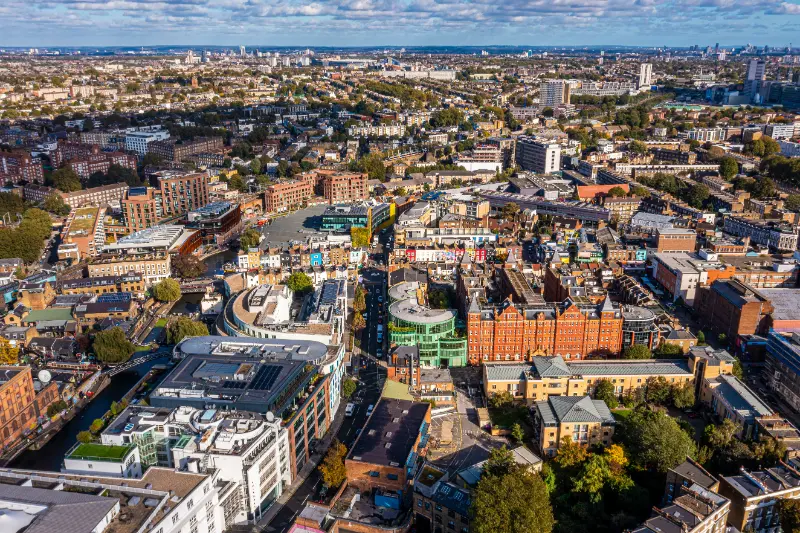
This is also a useful reminder that Camden’s alternative reputation developed within a neighbourhood shaped by canals, railways, warehouses and working infrastructure. The market culture came later. Travel becomes more interesting when you notice what a place was before it became famous for what it sells now.
Music history: choose current venues as well as famous names
Camden has strong associations with punk, indie, rock and live music, and many artists are linked to local venues. However, music districts change. Clubs close, management changes and nostalgia can overpower reality. Check current venue programmes rather than assuming every name in an old guide still offers the same experience.
If music matters to you, build the visit around an actual performance. The neighbourhood is far more memorable after dark when you have a reason to stay than when you simply photograph exteriors associated with famous musicians.
Street food: sample intelligently
Camden offers an enormous amount of street food, which is part of the attraction but also a source of decision fatigue. Walk through the main food area once before buying. Portions can be large, so sharing two different dishes may be more interesting than committing immediately to the first stall with a queue.
If food hygiene, allergies or dietary needs are important, ask the trader directly and do not assume labels cover every risk. For broader market choices across London, compare Camden with Borough, Spitalfields and others in our London markets guide.
Add Primrose Hill for contrast
From the northern/western edge of Camden, Primrose Hill is a logical extension. The walk takes you away from the market intensity and toward one of London’s classic skyline viewpoints. The hill itself is free and works especially well in clear late-afternoon light.
Do not add it if your schedule is already overloaded. A slow market visit plus canal walk may be enough. But if you want to understand why neighbourhood-based itineraries work in London, Camden to Primrose Hill is an excellent example: commercial chaos becomes residential streets and then open parkland within a relatively short walk.

A half-day Camden route
Start at Chalk Farm, enter the Stables side of the market, work south through the main trading areas, pause by Camden Lock, then walk a section of the Regent’s Canal. From here choose your ending: continue west toward Primrose Hill/Regent’s Park, or return east toward King’s Cross if your evening plans are central.
This route avoids the common back-and-forth between Camden Town station and the market. It also lets the neighbourhood change as you move. Pair it with our London neighbourhood guide if you want to build more days around areas rather than isolated attractions.
How to see Camden without spending the whole day in the densest crowd
Camden is easiest to understand when you separate the market from the neighbourhood around it. Arrive before the busiest lunch period if you want to browse stalls, then move toward the canal once the market lanes become congested. Camden Lock and the Stables have different layouts and trader mixes; walking both quickly is less rewarding than choosing the sections that actually match your interests.
The canal is the best escape valve. Walk west toward Regent’s Park and Primrose Hill for open space, or continue farther if you are following the Little Venice–Camden canal route. Music fans should also look beyond nostalgia: check current venue calendars for concerts instead of assuming a famous address automatically produces a good night on the date you visit.
Timing, food and what to skip
Peak lunchtime can make choosing food harder, not better. Browse first, note two or three stalls and return after comparing them. If your priority is vintage shopping, music culture or street photography, give those interests the time; you do not need to sample every food hall. The neighbourhood is also a practical bridge to Regent’s Park, London Zoo and Primrose Hill, so it can form a coherent north-London day without repeated Tube journeys.
Travellers who want market history or a guided food angle can compare Camden tours on GetYourGuide. If you are independent, arrive with one clear reason to visit and allow the canal or park to become the second half of the experience.
Camden practicalities that make a real difference
The market complex contains narrow passages, stairs and very busy pinch points, so travellers with a pushchair or reduced mobility should look at the current access information before choosing the busiest Saturday lunchtime. The canal towpath is flatter in many sections but can also become crowded with cyclists and walkers. If you want a calmer route, move away from the market entrance before joining the canal.
For food, do one reconnaissance loop before buying. Camden’s density encourages impulse purchases, and carrying several dishes through a crowd is rarely enjoyable. If you are continuing to Primrose Hill or Regent’s Park, buying one portable item and saving a proper meal for later can make the whole afternoon easier. The goal is to use Camden’s variety, not be trapped by it.
Frequently asked questions
Is Camden Market open every day?
The main market operates daily, but individual sections and traders can keep different hours. Check the official market site before travelling if a specific shop or food hall matters to you.
Is Camden better on a weekday or weekend?
Weekdays are easier for browsing; weekends have more intensity and atmosphere. Choose based on your tolerance for crowds rather than assuming one is universally better.
How long should I spend in Camden?
Two to three hours is enough for the market and a short canal walk. Half a day is better if you add Primrose Hill, Regent’s Park or a longer canal section.
Which station should I use?
Camden Town is closest to the main high street, Chalk Farm is useful for the northern/Stables side, and Camden Road connects to the Overground.
Official information and final planning note
For details that can change — opening times, temporary closures, booking rules, access arrangements and special events — check the official pages before travelling: Camden Market official visitor information.
Camden works best when the market is only one chapter. Pair it with the canal, Primrose Hill, Regent’s Park or a live-music plan and the area feels far less like a crowded shopping stop.
Eating your way through Camden
If market food is a priority, compare Camden with other areas in our London street-food guide.