
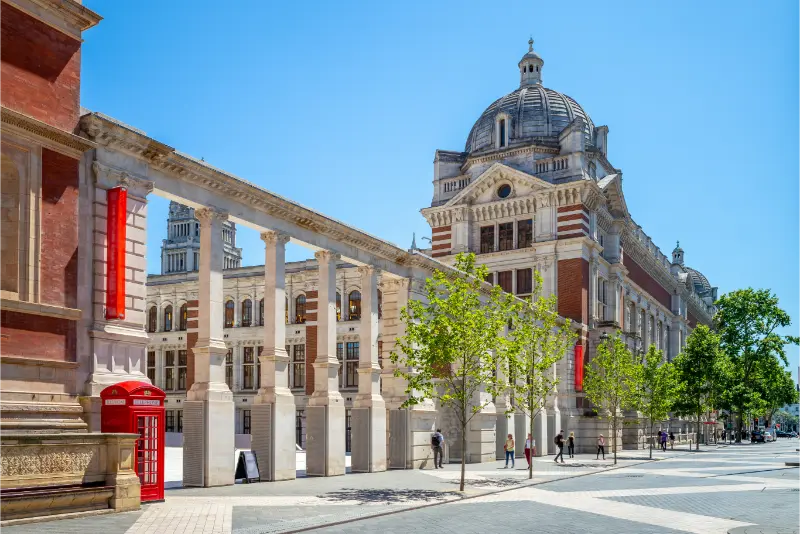
The Victoria and Albert Museum is the South Kensington museum most likely to surprise people who think they are “not museum people”. Its collections move across fashion, sculpture, furniture, photography, jewellery, architecture, ceramics, theatre and design. That variety is the reason it is wonderful — and the reason first-time visitors can lose an hour simply trying to decide where to begin.
The right approach is not to cover the V&A. It is to build a route around two or three kinds of objects you genuinely want to see, then let the museum distract you a little. General admission is free and no booking is currently required for the permanent collections, although temporary exhibitions may be ticketed. Pair this guide with our Kensington guide for a full South Kensington day.
| Best for | Art, fashion, design, decorative arts, architecture and photography |
|---|---|
| General admission | Free; temporary exhibitions may be charged |
| Good first visit | 2–3 hours |
| Current hours | Daily 10:00–17:45; Friday until 22:00, with some galleries closing earlier |
| Nearest station | South Kensington |
Choose a theme before you arrive
The V&A contains far more than most visitors expect. A first visit works best if you choose one broad interest — fashion, sculpture, decorative arts, design, photography or historic interiors — and then add a second that contrasts with it. This prevents the museum from becoming a sequence of beautiful but disconnected rooms.
The building is part of the collection
Do not rush from object to object without looking at the museum itself. The courtyards, staircases, historic rooms and transitions between galleries are part of the experience. The V&A is particularly rewarding for travellers who enjoy architecture because the building reveals different periods and attitudes to display as you move through it.
A first-time 2.5-hour route
- Begin with one high-priority collection rather than the nearest gallery.
- Spend around 45 minutes in that section without trying to read every label.
- Cross to a contrasting gallery or medium.
- Take a café or courtyard break if the museum is busy.
- Finish with one spontaneous gallery chosen because something on the map or doorway caught your attention.
Why Friday evening can be useful
The V&A currently stays open until 22:00 on Fridays, although some galleries close earlier. That creates a rare opportunity to move a major museum out of the middle of a sightseeing day. A Friday evening visit can work especially well after Kensington Gardens, Chelsea or a South Kensington lunch. Check the day’s gallery availability before relying on a specific room late in the evening.
Temporary exhibitions: book only if they are genuinely your priority
The V&A is known for major temporary exhibitions, but the permanent collection is already enormous and free. Do not assume you need a paid exhibition to make the visit worthwhile. If a temporary show is the reason you are coming, book it first and treat the permanent galleries as a flexible extra. If not, start free and decide how much museum time you really want.
Current practical information
V&A South Kensington currently opens daily from 10:00 to 17:45 and until 22:00 on Fridays, with some galleries closing earlier. General admission is free and no booking is required. Temporary closures and special events do occur; the museum has already published specific gallery closures and operational changes for late September 2026. Always check the official V&A visit page for your date.
A note about the Fashion Gallery
The V&A’s Fashion Gallery is undergoing redevelopment and is currently expected to reopen in autumn 2028. That is exactly the kind of detail that makes old online guides misleading. Fashion remains visible through other displays and exhibitions, but visitors travelling specifically for the traditional gallery should verify the current programme before planning the day around it.
The V&A with children
The museum can work very well for children if you convert “art and design” into observation games: find an object made for a purpose you do not recognise, choose the strangest chair, compare clothing from different periods, or sketch one decorative pattern. For younger children, a shorter visit is usually better than expecting them to follow an adult highlights list.
If your family wants more overtly interactive content, consider splitting South Kensington across two days and visiting the Science Museum separately.
Where to go afterwards
Walk north for Kensington Gardens and Hyde Park, west for more of Kensington, or south toward Chelsea. The museum is also close enough to Knightsbridge for shopping, but the transition from a thoughtful design museum directly into crowded retail streets can feel abrupt. A garden walk often makes a better reset.
Rainy-day value
Because there is no need to pay for permanent-gallery entry, the V&A is excellent for flexible weather planning. You can visit for 90 minutes, leave when the rain stops and return another day without feeling that you must extract value from an expensive ticket. That flexibility is one reason it belongs in our rainy-day London strategy.
Accessibility and quieter times
The museum lists step-free entrances and accessibility support on its official website. It also notes that opening time and the period toward closing are typically quieter, while weekends, school holidays and some Friday late events can be busy. Visitors who need a calmer environment should use that information rather than assuming evenings are always quieter.
Frequently asked questions
Is the V&A free?
Yes, general admission to the permanent collection is free. Temporary exhibitions and some events may require tickets.
Do I need to book?
The museum currently states that general entry does not require booking. Paid exhibitions may need advance tickets.
How long should I spend?
Two to three hours is a strong first visit. Design enthusiasts can easily spend most of a day.
Which South Kensington museum should I choose?
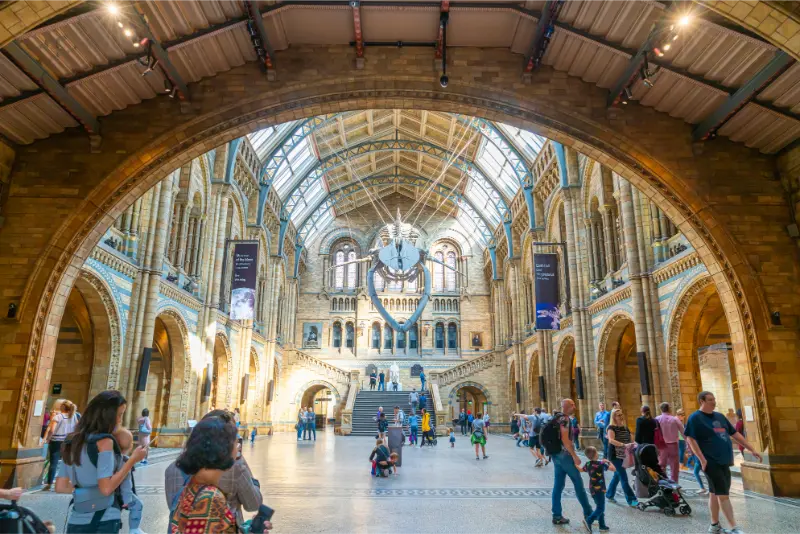
Choose the V&A for art, design and decorative culture; Natural History for animals, Earth and evolution; Science Museum for technology, engineering and interactive learning.
The V&A rewards selective curiosity
A successful visit is not measured by floors completed. It is measured by the number of objects that make you look twice. Choose a few interests, use the museum’s free admission to remove pressure, and allow one unplanned detour. That combination captures what the V&A does better than almost any other London museum: it makes the design of ordinary things feel historically important.
Choose an object story instead of a chronological marathon
The V&A is most rewarding when you follow a question: how did people dress, furnish homes, communicate status, design everyday objects or borrow ideas across cultures? That approach creates a thread through a collection that would otherwise feel almost impossibly broad. Pick a material—ceramics, metalwork, textiles, photography—or a subject such as fashion or furniture and let that become the visit.
You do not need to understand art history in advance. Read labels selectively and spend longer with objects that make you curious. The museum’s strength is the ability to move from a tiny domestic object to a monumental cast or architectural fragment within minutes.
Use the building itself as a reset between galleries
When visual fatigue sets in, stop looking at cases. Walk through the central spaces, pause in the courtyard when conditions allow, or sit somewhere without trying to “consume” another object. This is particularly important at the V&A because dense decorative displays can make twenty minutes feel like an hour.
A short break often restores attention better than switching immediately to a different museum. If you still want a second South Kensington institution, decide after the break rather than before the day starts.
Fashion, design and decorative arts for visitors who think they dislike museums
People who say they are “not museum people” often respond well to the V&A because the collection is connected to things used in real life: clothes, chairs, jewellery, posters, photographs, buildings and household objects. Start with a subject you already care about. A traveller interested in clothing can ignore entire wings without guilt; an architecture enthusiast can do the same.
This is also a good museum for teenagers with visual or creative interests because the visit can be based on design choices rather than on memorising dates. Give everyone permission to choose one object worth discussing at lunch.
Pair the V&A with the neighbourhood, not only with other museums
South Kensington is more than Exhibition Road. After the museum, walk toward Kensington, the Royal Albert Hall exterior, Hyde Park or quiet residential streets rather than automatically entering the Natural History Museum next door. The contrast between collection and neighbourhood gives the day better rhythm.
If the V&A is your main cultural stop, a long lunch or park walk is not wasted time. It is what keeps the museum from blending into every other indoor attraction on the trip.
Photography without turning the visit into documentation
The V&A is one of the easiest museums to over-photograph because almost every room contains visually striking objects. A better method is to photograph only pieces that trigger a question, then note the gallery or object label so you can find the context later. Hundreds of unlabelled phone images become visual clutter almost immediately.
If you are travelling for design inspiration, a short written note about why an object works—proportion, material, colour, typography, construction—is often more useful than another wide photograph of a display case.