

The Natural History Museum is one of London’s easiest attractions to underestimate. Admission to the permanent galleries is free, the building itself is spectacular and the collection is huge, so many visitors arrive with no plan and assume they can simply “see the museum”. That usually produces two hours of backtracking, crowded corridors and the feeling that the best rooms must still be somewhere else. A better visit starts by choosing what kind of museum day you actually want: dinosaurs and family favourites, Earth and human origins, architecture and iconic specimens, or a broader highlights route.
This guide is designed for a first visit of roughly two to four hours. It connects naturally with our Kensington guide and London with kids guide, because South Kensington works best when you treat the museums as a cluster rather than three unrelated buildings.
| Best for | Families, natural history, dinosaurs, architecture and rainy days |
|---|---|
| Admission | Permanent galleries are free; some exhibitions and events are ticketed |
| Typical visit | 2–4 hours for a focused first visit |
| Nearest station | South Kensington |
| Best strategy | Choose two or three priority zones before entering |
What to prioritise on a first visit
Start with one headline gallery you would be disappointed to miss. For many families that means dinosaurs; for other visitors it is the Hintze Hall experience, mammals, minerals, human evolution or Earth science. The museum is too large for a meaningful “everything” route in one morning, and trying to cross every gallery often means spending more time navigating than looking.
The smartest sequence is to combine one busy priority with one quieter interest. If dinosaurs are essential, see them early and then move into a less crowded collection. If you are primarily interested in architecture, allow time to look at the building rather than treating its staircases and decorative details as corridors between exhibits.
Hintze Hall is not just the entrance
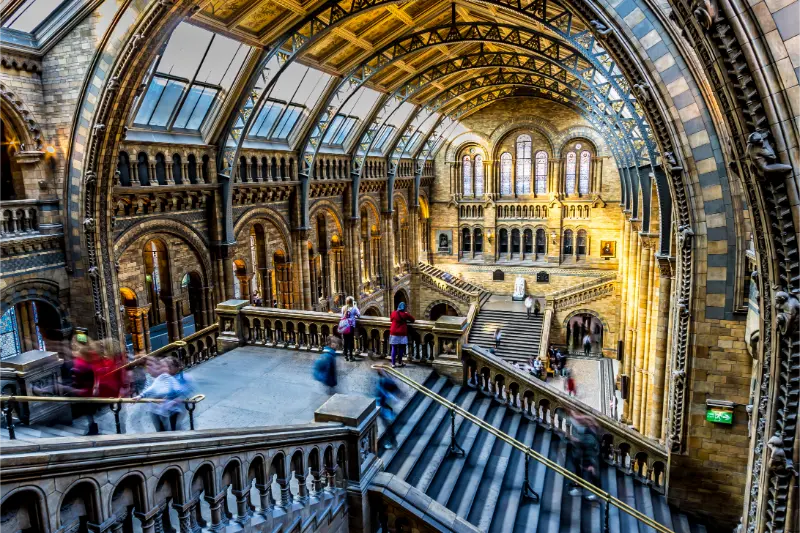
The central hall is the museum’s visual anchor and deserves more than a quick photograph. Look up, walk to different levels and notice how the architecture frames the suspended blue whale skeleton. It is also a useful orientation point: when the museum begins to feel confusing, return mentally to the central hall and choose the next zone rather than following whichever crowd happens to pass.
Dinosaurs without turning the whole visit into a queue
The dinosaur galleries remain a major draw, especially during weekends and school holidays. If they are your priority, arrive close to opening or book a free general-entry slot and go there before the museum becomes busiest. Families with children who are only mildly interested in dinosaurs may get more value from spreading time across animals, Earth science and interactive displays instead of waiting for one famous section.
A 2-hour first-visit route
- Enter and spend time in Hintze Hall rather than rushing through it.
- Choose one major collection such as dinosaurs, mammals or Earth science.
- Add one contrasting gallery that reflects your own interests.
- Take a short break before deciding whether you genuinely want another zone.
- Finish through the central hall and leave time for a walk on Exhibition Road or in Kensington Gardens.
A 4-hour route for curious visitors
With four hours you can explore much more, but breaks become important. Museums are tiring in a way that is easy to underestimate: reading labels, standing, navigating crowds and making constant choices all drain attention. A café break or twenty minutes outside can improve the second half of the visit more than forcing another gallery into the schedule.
One useful pattern is natural history first, lunch or coffee around Exhibition Road, then a second museum for only one hour. The Kensington itinerary explains why combining two focused museum visits can be more satisfying than spending an entire day inside one enormous institution.

Visiting with children
The museum is one of London’s strongest family attractions because children can engage at very different levels. Young children may respond to scale and animals; older children can follow scientific themes. The practical challenge is crowd management. Agree on a meeting point for older children, use toilets before the busiest sections, keep snacks and water in mind, and avoid promising that you will “see everything”.
If your family needs more hands-on science, consider pairing this museum with the nearby Science Museum on a separate half-day rather than trying to do both in full on the same day.
When to go
Weekday mornings outside school holidays are usually the easiest choice. Weekends, wet-weather days and school breaks can be much busier. The museum currently opens daily from 10:00 to 17:50, with last entry at 17:30, but special closures occur. The official visitor page notes a closure on 9 October 2026 and the usual Christmas closure on 24–26 December, so always check current Natural History Museum visitor information before travelling.
Do you need to book?
The permanent galleries are free. The museum advises that weekends and school holidays can be busy and says a free entry ticket can guarantee entry. That makes advance booking particularly useful when the museum is a fixed part of a short itinerary. Paid exhibitions and events have separate tickets and should be checked independently.
What to combine nearby
South Kensington is one of London’s best museum clusters. The V&A is ideal if you want art, fashion and design; the Science Museum is better for technology and interactive family experiences. Kensington Gardens gives you an outdoor reset, while Knightsbridge and Chelsea provide different options for food and an evening walk. Do not automatically combine all three museums just because the entrances are close.
Rainy-day strategy
The Natural History Museum is an obvious rainy-day choice, which is precisely why it can become especially crowded when the weather deteriorates. If rain is forecast for the entire city, arrive early. If showers are intermittent, use the museum as one anchor and move outside during dry windows. Our rainy day London itinerary gives more flexible combinations.
Accessibility and practical comfort
The museum publishes detailed accessibility information, including entrances, lifts and facilities. Travellers with mobility needs should check the official site before arrival because gallery closures, lift maintenance and event layouts can change. For everyone else, comfortable shoes matter more than they seem: several hours on hard museum floors can make the rest of a Kensington day feel much longer.
Frequently asked questions
Is the Natural History Museum really free?
Yes, general admission to the permanent galleries is free. Some temporary exhibitions and events require paid tickets.
How long should I allow?
Two to four hours is a good first-visit range. Specialists can easily spend longer, while families with small children may prefer a shorter, high-energy visit.
Can I do the Natural History Museum and Science Museum on the same day?
Yes, but treat one as the main visit and the second as a focused highlights stop. Trying to explore both comprehensively is exhausting.
Is it worth visiting if I do not care about dinosaurs?
Absolutely. The building, mammal collections, Earth science, minerals and broader natural-history galleries provide many different routes through the museum.
The better way to think about this museum
The Natural History Museum is not a checklist attraction. Its value is concentration: one object or gallery can send you into a completely different subject than the one you expected to explore. Give yourself a plan, but leave enough space to abandon it when something genuinely catches your attention. That balance is what turns a free museum visit into one of London’s strongest cultural experiences.
A smarter route when the museum is crowded
The Natural History Museum is easiest to enjoy when you stop thinking in terms of “floors completed” and start thinking in themes. If the dinosaur galleries are the priority, go there early and accept that other parts of the building may become optional. If architecture and atmosphere matter more, spend time in Hintze Hall, the grand staircases and quieter side galleries before joining the busiest zones. Families often do better with one high-energy section followed by a calmer gallery rather than stacking several spectacular spaces back to back.
When one gallery is congested, move on instead of waiting simply because it appears next on your mental checklist. The museum is large enough that a temporary change of order rarely costs you anything. Keep a photo of the current floor map on your phone and use the museum’s own signs rather than trying to navigate by memory from an old blog route.
Dinosaurs are not the only reason to come
Visitors sometimes assume the museum is mainly for children who love dinosaurs. In reality, the collections span geology, evolution, biodiversity, minerals, oceans and the history of scientific collecting. Adults who normally avoid family attractions can have an excellent visit by choosing one subject—earthquakes and volcanoes, minerals, birds, human evolution, marine life—and treating the museum as a specialist collection rather than a blockbuster.
This is also why the Natural History Museum pairs poorly with a second huge museum if you try to “finish” both. A focused two- or three-hour visit followed by lunch and a walk through Kensington Gardens is often stronger than six consecutive hours indoors.
Family pacing: use the building as part of the experience
With children, alternate object-heavy galleries with spaces where simply looking at the architecture feels like a change of pace. Plan a proper food and toilet break before everyone is exhausted, not after. If a child has one favourite subject, protect that first. The rest of the museum can be discovery rather than obligation.
For a full family day, compare this guide with our Science Museum guide and London with kids guide. Two museums can work when you intentionally keep both visits short; they become tiring when each is treated as a half-day mission.
Temporary exhibitions and gallery closures can change the ideal route
Large museums rotate displays, close rooms for conservation and host ticketed exhibitions that alter crowd flow. If one object or temporary show is the reason for your visit, check the official museum site on the morning of the visit. Do not rely on a route written months earlier to tell you that every gallery will be open.
This is one of the few London attractions where flexibility is a genuine advantage. General admission is free, so you can leave while you are still enjoying yourself and return on another day if the museum becomes too busy or your interests change.