
Greenwich is one of the best examples of why a London trip should not stay trapped in Zone 1. In one compact day you can arrive by river, walk through a UNESCO World Heritage area, step aboard the Cutty Sark, visit major free museums, stand on the Prime Meridian, climb through a royal park and look back at the modern skyline. It feels distinct from central London without requiring a day trip outside the city.
| Best for | Maritime history, views, parks, families, a slower full day |
|---|---|
| Minimum time | Half a day; a full day is much better |
| Useful arrival | River boat, DLR to Cutty Sark, train to Greenwich |
| Best strategy | Arrive one way and leave another to make the journey part of the day |
Arrive by river if your schedule allows
Approaching Greenwich from the Thames gives the day a narrative. Central piers link with regular river services, and the view changes from historic central London through Docklands toward maritime Greenwich. The journey is not the cheapest public transport option, but it doubles as sightseeing and can replace a separate cruise.
ROUTE MAP
Greenwich full-day itinerary map
Use the map as a planning overview. The numbered markers follow the order suggested in this guide; exact walking and transport choices can change with closures, weather and your bookings.
- Greenwich Pier
- Cutty Sark
- Old Royal Naval College
- National Maritime Museum
- Queen’s House
- Royal Observatory
- Greenwich Market
If you are budget-focused, take rail or DLR and use the river for the return, or skip it entirely. Greenwich remains worthwhile regardless of arrival method. The key is not to spend an hour making complicated transfers just to reproduce someone else’s perfect itinerary.
Cutty Sark: decide whether ships are one of your interests
The Cutty Sark is a surviving 19th-century tea clipper and one of Greenwich’s defining sights. You can appreciate its exterior and the surrounding dry dock area without a ticket, but the paid visit makes more sense if maritime technology, engineering or family-friendly interactive exhibits appeal to you.
Do not automatically buy every Greenwich ticket as a bundle. Royal Museums Greenwich offers combined products, but the best value depends on what you actually want to enter. If your main interests are the park and free museums, you can have an excellent day with far less paid admission.
Old Royal Naval College and the architecture of maritime Greenwich
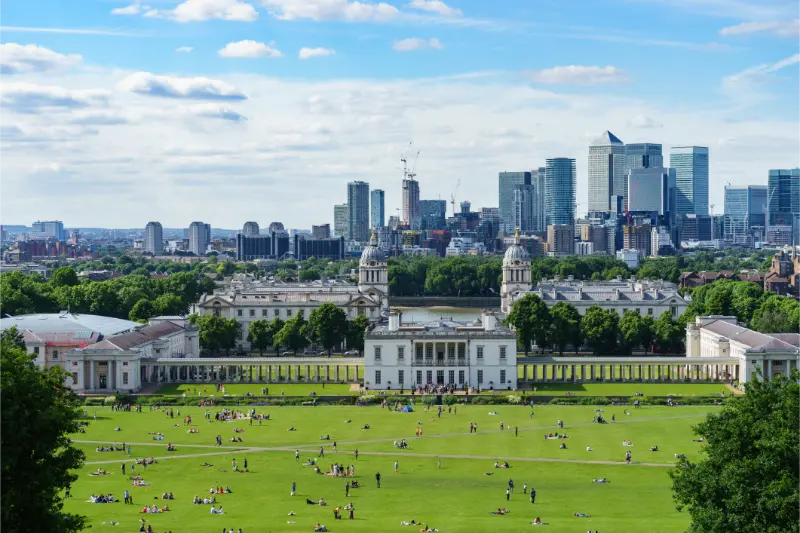
The riverside ensemble around the Old Royal Naval College gives Greenwich much of its monumental character. Even if you do not enter a ticketed interior, walk through the grounds and look back toward the river. The symmetry and open spaces create a very different London from Soho or Westminster.
Allow time to cross the site slowly rather than walking directly from the pier to the Observatory. Greenwich is unusually good at rewarding the spaces between headline attractions. The grounds, riverside and views across to Canary Wharf explain how maritime and modern London sit opposite each other.
National Maritime Museum and Queen’s House: strong free anchors
The National Maritime Museum and Queen’s House are part of Royal Museums Greenwich and provide a way to add substantial indoor time without turning the day into a chain of expensive admissions. They are especially useful in mixed weather. The Maritime Museum covers seafaring, exploration, trade and naval history, while the Queen’s House adds art and architecture.
Families can use the museum as a reset between outdoor sections. Adults who are not maritime specialists should resist trying to read every label; choose one or two galleries and preserve energy for the park. Greenwich works best as a varied day rather than a museum marathon.
Greenwich Park: climb beyond the Observatory viewpoint
The climb through Greenwich Park to the Royal Observatory is short but noticeable, especially after a long morning. The reward is one of London’s most recognisable skyline views. The Royal Parks also highlights One Tree Hill as a quieter viewpoint within the park, which is useful if the main terrace is packed.
The park is more than a viewpoint. It contains historic avenues, gardens, old trees and traces of earlier occupation. If the weather is good, give it at least an hour beyond the standard photo. This is where Greenwich stops feeling like a bundle of attractions and starts feeling like a destination.
Royal Observatory and the Prime Meridian: understand what you are paying for
The famous Prime Meridian runs through the Royal Observatory site, where the history of longitude, navigation and timekeeping is explained. The paid Observatory visit is valuable if those subjects interest you; the attraction is not simply the act of placing one foot on either side of a line.
If you are travelling with children, the science and navigation story often works better when you frame it around a question: how did sailors know where they were? Why does the world need standard time? That turns a photo stop into a memorable concept.
Greenwich Market and where to eat
Greenwich Market is convenient because it sits between the river and park route. It combines food and retail traders, and the surrounding streets add cafés and pubs. It can become very busy at weekends, so treat it as one option rather than the only possible lunch stop.
If the market is packed, walk another few minutes before deciding. A quieter meal can be worth more than eating standing up simply because a stall appears in every online guide. For market comparisons across the city, see our London markets guide. For Greenwich itself, the dedicated Cutty Sark guide, Royal Observatory guide and London by boat guide make it easier to decide where to spend the limited hours.
A full-day Greenwich itinerary
A balanced day is: arrive by river, see Cutty Sark, cross the Old Royal Naval College, visit either the National Maritime Museum or Queen’s House, have lunch, walk through Greenwich Park, then enter the Royal Observatory if it genuinely interests you. Finish by descending through the park and leaving by DLR or train.
Using a different return mode is more than a transport trick. The DLR gives elevated views through Docklands and makes the contrast with historic Greenwich obvious. If you are already using contactless travel, our London transport guide explains fares and payment basics.
- Morning: river arrival + maritime core.
- Lunch: market or nearby streets.
- Afternoon: park + Observatory.
- Return: DLR or train for a different view of east London.
Important 2026–2028 Royal Observatory changes
Greenwich needs a date-specific plan because the Royal Observatory is in the middle of the First Light transformation. Royal Museums Greenwich states that the historic Observatory remains open until 2 November 2026. After that the site closes temporarily; the Meridian Courtyard is scheduled to reopen in summer 2027, while completion of the wider transformation is planned for spring 2028. The Peter Harrison Planetarium and Astronomy Centre are already closed as part of the works.
If you are visiting before 2 November 2026, the classic sequence—park, Prime Meridian, Flamsteed House and the hilltop view—still makes sense, subject to day-specific closures. If you are visiting during the temporary closure, do not cancel Greenwich. Build the day around Cutty Sark, the Old Royal Naval College, National Maritime Museum, Queen’s House, Greenwich Market and the park itself. Royal Museums Greenwich is also moving astronomy programming into the National Maritime Museum during the project.
A route that still works during the transformation
Arrive by river if the timetable and weather cooperate, because the approach explains Greenwich’s relationship with the Thames. Visit Cutty Sark early if it is a priority, cross the naval-college grounds, choose one free museum, then have lunch before walking uphill through Greenwich Park. The skyline viewpoint remains valuable even when part of the Observatory experience is unavailable. Return by DLR or rail so the journey back shows you Docklands from a completely different angle.
If you prefer a guided day or want transport bundled with an activity, compare Greenwich and Thames experiences on GetYourGuide. Whatever you choose, check the official First Light project page shortly before travelling because phased access will continue to change.
Which Greenwich museum should you choose?
If time is limited, choose according to interest rather than proximity. The National Maritime Museum gives the broadest maritime story and is the easiest free anchor for families; the Queen’s House is smaller, calmer and more art-focused; Cutty Sark is the most tactile ticketed experience. During the Royal Observatory transformation, this choice matters even more because the lower part of Greenwich can easily fill half a day without climbing the hill. A museum plus the park is usually more satisfying than trying to rush every site.
Frequently asked questions
Is Greenwich a day trip from London?
Greenwich is part of London, not a separate day trip. It is easy to reach by river, DLR or train and fits naturally into a London itinerary.
Is Greenwich worth visiting on a first trip?
Yes if you have at least four days or strong interest in maritime history, views or parks. On a very short first visit, prioritise central essentials first.
What is free in Greenwich?
Walking the historic area and park is free, and major museum options such as the National Maritime Museum and Queen’s House have free general admission, while attractions such as the Royal Observatory and Cutty Sark are ticketed.
How long does Greenwich take?
Half a day covers the highlights quickly; a full day is far more comfortable if you want museums, the park and a paid attraction.
Official information and final planning note
For details that can change — opening times, temporary closures, booking rules, access arrangements and special events — check the official pages before travelling: Royal Museums Greenwich, Greenwich Park – The Royal Parks.
Greenwich remains one of London’s strongest full-day districts even while the Observatory changes. Its value comes from the river, maritime collections, park, architecture and skyline working together, not from a single Meridian photograph.
Plan Greenwich’s two headline paid attractions
If you want to go beyond the free museums and park, read our dedicated Cutty Sark guide and the date-sensitive Royal Observatory Greenwich guide, which explains the 2026–28 First Light closure and reopening phases.
Explore the modern Docklands nearby
For a completely different east-London landscape, continue with our Canary Wharf and Docklands guide.